
Hiring AI developers is one of the most important decisions a business can make today. Artificial Intelligence (AI) isn’t just a trend; it’s a game-changer, revolutionising sectors ranging from healthcare and finance to retail and supply chain management. AI powers smarter decisions, automates complex processes, and creates intelligent products that can redefine customer experiences and business growth.
Most organizations face the challenge that without the right individual, even the best AI plans won’t work. Skilled developers are essential in the organisation to transform ideas into effective, functioning AI solutions. Learning how to hire AI developers is not only important but essential for any business aiming to stay ahead.
Whether you’re a startup building your first AI product, a large company scaling AI projects, or a manager in charge of hiring, knowing how to hire AI developers is essential. In this guide, you will learn everything you need to know, from understanding AI developer roles and the talent market to finding the right candidates, evaluating their skills, setting budgets, and keeping your top AI talent.
The Rising Demand for AI Developers Across Industries
Every day, we make use of apps like predictive typing, personalized recommendations, or voice assistants. All of these work because of skilled AI developers. Today, AI isn’t just an added feature; it has become a must-have for businesses that want to grow, compete, and stay relevant.
Study indicates that AI job postings have grown by 119% globally in just the last two years, showing how quickly demand for skilled AI developers is rising. At the same time, millions of AI roles remain unfilled due to a shortage of qualified talent, making it harder for businesses to hire AI developers who can drive innovation and growth.
From startups building generative AI products to large enterprises driving digital transformation, hiring AI developers has become a top strategic priority. Today, AI developers are among the most valuable and in-demand tech professionals, helping businesses turn ideas into practical, competitive solutions.
Different Types of AI Developers and Their Roles
Before you hire AI developers, it’s essential to understand the different roles within the AI ecosystem, especially the role of an AI application developer. Partnering with experts or an AI application development services provider can help address business needs such as rapid deployment, cost efficiency, and long-term scalability. Choosing the right AI role ensures your project aligns with your goals, budget, and timeline from the very start.
AI Developer
An AI developer is a multi-skilled professional who works across various areas of artificial intelligence. They create algorithms, train machine learning models, and integrate AI capabilities into software systems to solve real business problems and make them ideal for organizations building complete, end-to-end AI solutions.
AI App Developers
AI application developers specialize in building AI-powered web and mobile applications. They combine AI models with frontend and backend development, APIs, and user experience, making them a strong choice for creating chatbots, recommendation engines, AI-driven applications, and workflow automation tools.
Artificial Intelligence Developer
An artificial intelligence developer specializes in advanced AI technologies, including deep learning, neural networks, natural language processing (NLP), and computer vision. Their work involves designing, fine-tuning, and optimizing complex models, which makes them essential for high-complexity AI systems and data-intensive applications.
Freelance AI Developer
A freelance AI developer works on a contract or project basis, offering flexibility along with specialized AI expertise. This role is well-suited for short-term requirements, Proofs-of-Concept (PoCs), or testing AI ideas before investing in a full-time AI team.
AI Developers for Hire
AI developers for hire are pre-screened professionals sourced through agencies, talent platforms, or AI consulting firms. This option helps businesses quickly access experienced AI talent, particularly when rapid scaling, tight deadlines, and reliable technical expertise are critical.
You may also want to know the best AI for Writing Code
Must-Have Skills to Look for in AI Developers
When you plan to hire AI developers, keep this in mind: it’s not only about technical skills. The best AI developers understand your business goals and can turn ideas into practical, real-world solutions that deliver results.
Key Technical Skills:
A skilled AI developer should be comfortable working with common programming languages like Python and Java, and using popular AI and machine learning tools such as TensorFlow or PyTorch. They should know how to handle data using SQL (Structured Query Language) and analytics tools, build AI models for prediction and automation, and deploy AI solutions on cloud platforms so they can scale as your business grows.
You don’t need to know all the technical details because what truly matters when you hire AI developers is their ability to build reliable and scalable AI solutions that work smoothly in real business environments.
Essential Soft Skills:
AI developers don’t just rely on technical expertise; they also bring important people skills. They are strong problem-solvers who can break down complex challenges and find practical solutions. They communicate clearly, making it easy for non-technical teams to understand how AI works and why it matters. They collaborate closely with product, business, and marketing teams and stay focused on results, using AI to deliver real business value rather than just advanced technology.
Additional Skills:
Along with core skills, some AI developers bring added expertise that can make a big difference. This includes experience with MLOps (Machine Learning Operations) to deploy and manage AI models in real products, hands-on work with Large Language Models (LLMs), and a strong understanding of AI ethics and compliance to ensure solutions are responsible, secure, and trustworthy.
Which Hiring Model Is Right for AI Developers?
When you plan to hire AI developers, choosing the right hiring model is just as important as choosing the right talent. Each option has its own benefits and challenges, depending on your goals, budget, and timeline.
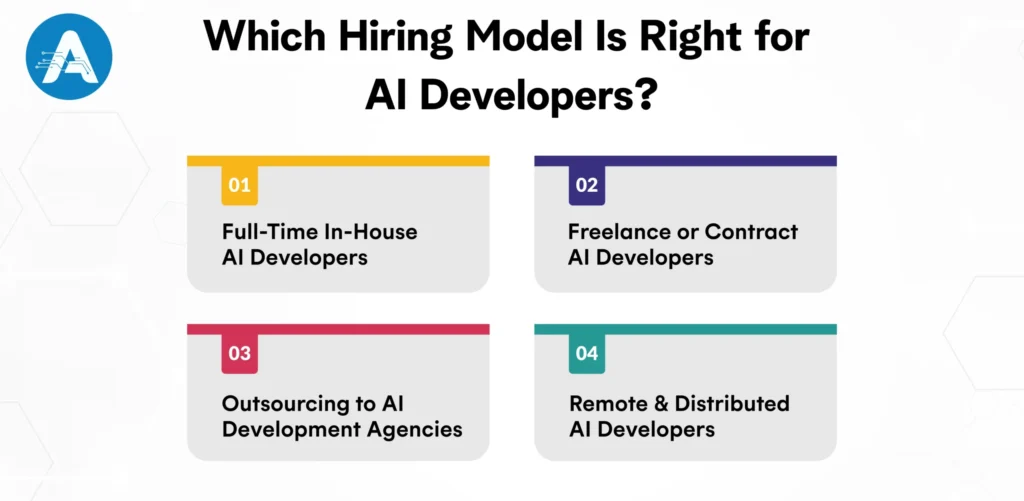
Full-Time In-House AI Developers:
Hiring full-time in-house AI developers gives you a team that deeply understands your product, users, and long-term business goals. These AI developers become part of your company culture and stay aligned with your vision over time. You also have better control over data security, workflows, and intellectual property.
However, this model comes with higher costs, including recruitment, salaries, benefits, and tools, and the hiring process can take several months. This approach works best when AI is a core part of your business strategy, and you are ready to invest for the long term.
Freelance or Contract AI Developers:
Working with a freelance AI developer is a flexible and faster way to get AI work done, especially for short-term or clearly defined projects. Many businesses hire AI developers on a contract basis for proof-of-concept development, data analysis, or specific AI integrations.
While this option is more cost-effective upfront, it can be harder to maintain consistency and fully integrate freelancers into your internal team. Freelance AI developers may also need closer management to ensure timelines and quality stay on track.
Outsourcing to AI Development Agencies:
Outsourcing to an AI development agency allows you to hire AI developers who can handle the entire project from planning to delivery. Agencies provide access to experienced, pre-vetted AI developers and usually follow structured processes, making timelines more predictable.
The downside is higher costs compared to freelancers and less direct control over day-to-day development decisions. This model suits companies that want quick results without building an in-house AI team.
Remote and Distributed AI Developers:
Hiring remote AI developers opens access to a global talent pool and helps manage costs more efficiently. Many businesses now hire AI application developers from regions such as Eastern Europe, Latin America, and India to find the right balance of skills, affordability, and time zone compatibility.
This approach works well for companies that want to scale quickly while maintaining flexibility and access to top AI talent worldwide.
How to Choose the Right AI Developer
When you plan to hire AI developers, using a clear evaluation process helps you avoid costly mistakes and find the right talent faster. Below is an easy, practical way to assess AI developers at every stage.
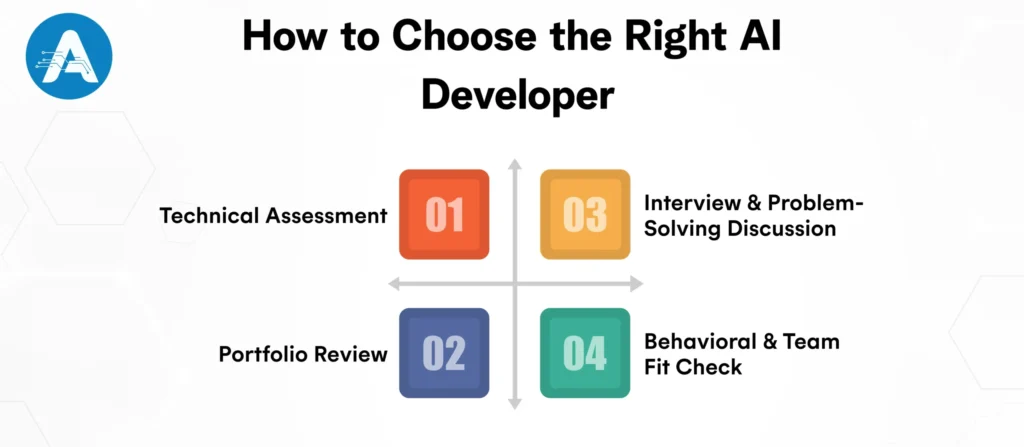
Technical Assessment
Start by testing practical skills. Ask candidates to complete a small coding task, build a basic machine learning model, or work with a sample dataset. This helps you understand how the AI developer applies knowledge, not just theory.
Portfolio Review
Review past work carefully. Look at GitHub repositories, Kaggle profiles, research demos, or previous AI applications. Strong AI app developers usually have hands-on projects that show real problem-solving ability.
Interview and Problem-Solving Discussion
Use simple, practical questions to see how the candidate thinks. Ask how they chose a model for a past project, how they improved performance, or how they handled missing or messy data. Good AI developers can explain complex decisions clearly.
Behavioral and Team Fit Check
AI developers often work with product, business, and marketing teams. Assess communication skills, collaboration style, and alignment with your company values. Team fit is just as important as technical expertise.
For example, a SaaS company interviewed AI developers for a customer support automation project. One candidate clearly explained how the AI solution would improve response times and user satisfaction. That AI developer later became the technical owner of the AI product.
You may also want to know AI App Development Services
How Much Does It Cost to Hire AI Developers?
When you hire AI developers, it’s important to remember that AI talent is highly sought after, and salaries reflect this demand. Experienced AI developers typically earn more than traditional software engineers due to their specialized skills and the business impact they deliver.
Average Salaries for AI Developers
In the United States and Western Europe, an AI developer can expect to earn between $120,000 and $180,000 per year, with highly specialized roles earning even more. In India, AI app developers usually earn between ₹12 to ₹24 lakh per year, depending on experience and expertise. For flexible arrangements, a freelance AI developer may charge anywhere from $40 to $160 per hour globally, depending on their skill level and the complexity of the project.
Plan Your AI Developer Budget
Many startups and growing companies opt to hire AI developers remotely or bring on freelance AI developers to balance costs while accessing top talent. This approach can help reduce expenses, but highly skilled developers with expertise in machine learning or generative AI often still command premium rates. Planning for these costs ensures you attract the right talent without compromising on quality.
Most importantly, salary is only one part of the picture when you hire AI developers. To attract the best talent, offer perks like flexible work arrangements, training and professional development budgets, equity options, and challenging projects that let them make an impact. Many AI developers care about growth and meaningful work as much as pay.
By planning your budget with these factors in mind, you can hire AI developers for your business effectively while keeping them motivated, productive, and committed for the long term.
Common Challenges When Hiring AI Developers
Hiring AI developers comes with its own set of challenges.
- Talent Shortage: Skilled AI professionals are in high demand, making recruitment competitive and sometimes difficult.
- Long Hiring Cycles: Screening, vetting, and onboarding can take several weeks or even months.
- Integration Issues: AI developers need to collaborate closely with product, business, and marketing teams, which can be challenging if processes aren’t well-defined.
- Expectation Misalignment: Business leaders may overestimate what AI can achieve, so it’s important to set realistic goals.
How to Overcome These Challenges:
To overcome these challenges, focus on clear communication, structured hiring processes, and realistic expectations. This helps you hire AI developers effectively and ensures they integrate smoothly into your team.
- Write clear and detailed job descriptions.
- Use structured evaluation tests to assess technical and soft skills.
- Align AI projects with your overall business objectives.
- Plan realistic timelines for hiring, onboarding, and project delivery.
Emerging AI Hiring Practices
As AI changes the way businesses operate, companies are changing how they hire. They now focus more on practical skills than degrees and are creating new roles like prompt engineers. Using AI-powered hiring tools and offering internal training programs are becoming key ways to attract and retain top AI talent.
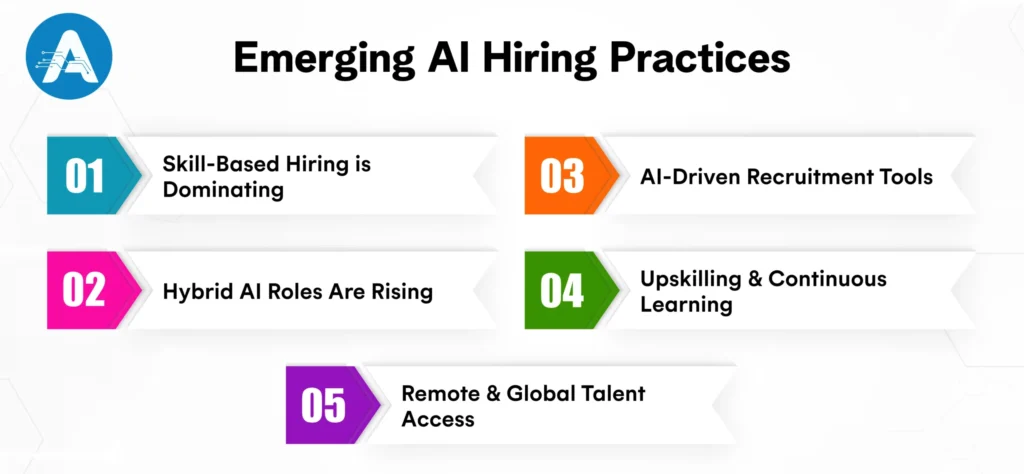
- Skill-Based Hiring is Dominating: Companies are shifting focus from degrees to practical AI skills. Portfolios, real projects, and hands-on experience now carry more weight than formal credentials.
- Hybrid AI Roles Are Rising: New positions like AI product managers, MLOps(Machine Learning Operations) specialists, and prompt engineers are in high demand, reflecting the growing complexity of AI applications.
- AI-Driven Recruitment Tools: Organizations are using AI-powered hiring platforms for resume screening, skill assessment, and candidate matching, making recruitment faster and more accurate.
- Upskilling and Continuous Learning: Through 2027, Gartner predicts that 80% of the engineering workforce will need to upskill in generative AI (GenAI) to stay relevant, prompting companies to invest in internal AI training programs to retain talent and remain competitive.
- Remote and Global Talent Access: Businesses are increasingly tapping into global AI talent pools, hiring remote developers to accelerate project delivery and leverage diverse expertise.
Steps to Hire AI Developers
Follow these clear steps to hire AI developers effectively. This guide will help you find, evaluate, and onboard the right AI developers for your business.
- Write clear and detailed job descriptions to attract the right AI developers and set expectations from the start.
- Use structured evaluation tests to assess both technical skills and soft skills of AI developers for better hiring decisions.
- Align AI projects with your business objectives so that the AI developers you hire deliver real value to your company.
- Plan realistic timelines for hiring, onboarding, and project delivery to ensure your AI developers integrate smoothly.
- This approach enables you to hire AI developers effectively and create a skilled, collaborative, and high-performing AI team
Conclusive Statement
Hiring AI developers is more than just filling technical roles. It is a strategic move that can shape the future of your business. Building the right team can accelerate innovation, improve efficiency, and keep your company competitive in an AI-driven world.
Whether you’re looking for an AI app developer, a freelance AI developer, or a full in-house team, careful planning, clear strategies, and smart hiring practices are essential. Partnering with a trusted AI development company or hiring the right talent ensures your business can lead the AI revolution instead of playing catch-up.
One of my friends worked on a business AI project where he had to choose between Haystack vs LangChain. He started with LangChain because it was quick to set up and easy to turn into a chatbot, and it worked well in the early stages. But once real documents and larger datasets were added, the answers became inconsistent. After incorporating Haystack into the search setup, the responses felt more reliable and easier to trust. That’s when it became clear the decision was not about choosing one tool over the other, but about using each where it worked best.
Today, companies are building AI chatbots, document search engines, internal knowledge assistants, and customer-facing AI tools. In nearly every discussion about these projects, the same two names consistently appear: LangChain and Haystack. Understanding how each tool fits different needs is the key to making the right choice for your AI project.
Why Haystack vs LangChain Matters?
Choosing between Haystack vs LangChain matters because both tools solve different problems in AI projects. LangChain is great when you want to build quickly, experiment, or create conversational features like chatbots. Haystack, on the other hand, is designed for accurate search and works better when your AI needs to pull reliable answers from documents. Understanding this difference early helps you avoid wrong answers, reduce rework, and build an AI system that actually performs well in real business situations.
What Is A Haystack?
In AI, Haystack is an open-source framework focused on search, question answering, and document-based AI. It is built to handle large amounts of data and is often used in systems where accuracy and reliability are critical.
Haystack works well for:
- Searching across millions of documents
- Building structured AI search pipelines
- Retrieving accurate, source-based answers
- Enterprise-level AI applications
Haystack focuses less on conversation and more on finding the right information first, then generating answers based on trusted data.
What Is LangChain?
LangChain is an open-source framework that helps you build AI applications using large language models. Instead of working with a single prompt, LangChain allows you to connect prompts, tools, memory, and external data into structured workflows called LangChain chains.
This makes it easier to create AI systems that can think through tasks, remember context, and interact with other tools or data sources.
LangChain is commonly used for:
- AI agents
- Reasoning-based workflows
- Conversational assistants and chatbots
- Fast testing and experimentation
You may also want to know AI Website Builder
Why Developers Choose LangChain or Haystack
Developers choose between LangChain and Haystack based on what their AI project needs most. While both tools are powerful, they serve different purposes, which is why the decision often comes down to speed versus accuracy.
Many developers prefer LangChain when they want to build quickly and experiment with AI features. It is especially popular for chatbots and conversational AI because LangChain chains make it easy to connect prompts, tools, and memory into flexible workflows. With a large community on GitHub LangChain, developers can move fast, test ideas easily, and build AI agents without much setup.
On the other hand, developers turn to Haystack when accuracy and reliable search are more important than rapid experimentation. Haystack is designed for document-heavy AI systems and works well as a Haystack search engine that pulls answers directly from real data. Its structured pipelines help reduce hallucinations, making it ideal for enterprise projects, internal knowledge bases, and compliance-focused applications.
Just as Haystack Rock in Oregon stands firm and precise in the ocean, Haystack provides a solid foundation for AI systems that need dependable, document-backed answers.
In simple terms, developers rely on LangChain for flexibility and fast development, and on Haystack when their AI system requires accuracy and trustworthiness.
Haystack vs LangChain: Understanding Their Core Philosophy
The key difference between Haystack vs LangChain is not superiority, but their approach to problem-solving.
Haystack: Search-First Approach
Haystack focuses on finding the right information before generating an answer.
It searches through large document collections, ranks the most relevant results, and then passes only trusted data to the language model. This helps reduce errors and keeps responses grounded in real content.
That’s why Haystack works best for search engines, document-based Q&A systems, and enterprise AI applications where accuracy, reliability, and transparency really matter.
LangChain: LLM-First Approach
LangChain puts the language model at the centre of the application.
The LLM decides what action to take, when to use tools, and how to respond to users. It connects prompts, tools, memory, APIs, and external services into one smooth workflow.
Because of this flexibility, LangChain is ideal for chatbots, AI assistants, workflow automation, and interactive applications where conversations and dynamic decision-making are important.
Haystack vs LangChain: Key Features Compared
| Core Aspect | Haystack | LangChain |
| Main Purpose | Finds the right information and answers questions accurately | Builds AI apps by connecting LLMs, tools, and logic |
| Best For | Search systems, document Q&A (Question & Answers), enterprise RAG (Retrieval- Augmented Generation) | Chatbots, AI assistants, automation workflows |
| Ease of Learning | Takes more time to learn | Easier to start, beginner-friendly |
| Chatbot Creation | Good support, but more structured | Excellent support for chatbots and conversations |
| Search Capability | Powerful, advanced search engine | Basic search features |
| Enterprise Readiness | Strongly built for enterprise use | Growing adoption in companies |
| Flexibility | More structured but very stable | Very flexible and customizable |
| Community & GitHub | Smaller but consistent community (Haystack GitHub) | Huge community and very active (GitHub LangChain) |
Haystack vs LangChain: How They Are Used in Real Life
Both tools are powerful, but they are used in different real-world situations. The right choice depends on what you are building and how accurate or flexible your system needs to be.
Consider Haystack, if:
- You are building a search system based on large documents (PDFs, manuals, knowledge bases)
- Accuracy and reliability are more important than creative responses
- You are deploying AI in an enterprise or regulated environment
- You need clear, explainable answers backed by real data sources
In real life, Haystack is commonly used by enterprises and research teams that need reliable, trustworthy information.
Consider LangChain, if:
- You are building a chatbot or AI assistant that talks naturally with users
- You want to build and test ideas quickly without a heavy setup
- You need the AI to use tools, call APIs, or take actions automatically
- You are experimenting with workflows, agents, or multi-step reasoning
In practice, LangChain is popular with startups and developers creating AI chatbots and smart interactive tools.
LangChain vs Llama Index: Key Differences and Use Cases
Another comparison that often comes up for teams at an AI development company is LangChain versus LlamaIndex. Both frameworks are powerful but serve slightly different purposes, and understanding their strengths can help teams choose or even combine them effectively.
LlamaIndex Strengths
LlamaIndex is primarily focused on data ingestion and indexing. Its main goal is to help organize and structure documents so that an AI system can access and query them efficiently.
Key Advantages:
- Structured document querying: If your project involves PDFs, spreadsheets, or large knowledge bases, LlamaIndex makes it easy for the AI to locate exactly what it needs.
- Optimized for retrieval-heavy tasks: LlamaIndex is designed to handle large volumes of data and return relevant information quickly, making it ideal for search and knowledge-based applications.
LangChain Benefits
LangChain is designed for flexible orchestration and advanced AI workflows. It focuses on connecting language models with tools, APIs, and logic to help developers create more dynamic applications.
Key Advantages:
- Flexible AI workflows: LangChain can manage multi-step tasks, handle dynamic decision-making, and integrate multiple tools or agents seamlessly.
- Ideal for building AI applications: From chatbots to automated systems, LangChain gives you the structure to control how the AI interacts with data and other components.
- Adaptable and scalable: Whether you are experimenting with small prototypes or deploying full-scale AI solutions, LangChain can scale to fit your needs.
Using LlamaIndex and LangChain in AI Applications
Many teams building advanced AI systems find that combining LlamaIndex and LangChain delivers the best results. LlamaIndex excels at organizing and retrieving large volumes of data, while LangChain provides the flexibility to process that data, generate intelligent responses, and orchestrate complex AI workflows.
This approach is especially valuable for companies offering AI application development services, as it enables developers to:
- Build highly accurate AI applications: LlamaIndex ensures the AI has access to the most relevant documents and data.
- Create flexible, dynamic workflows: LangChain handles multi-step reasoning, agent-based decisions, and integration with external tools or APIs.
- Develop scalable solutions: From chatbots to enterprise automation systems, this combination supports both small prototypes and full-scale AI deployments.
By integrating these frameworks, teams can deliver powerful, reliable, and adaptable AI applications, maximizing both accuracy and flexibility.
You may also want to know the best AI Programming Language
Key AI Statistics
The popularity of AI frameworks is clear from platforms like GitHub LangChain and Haystack GitHub, where developers actively contribute and share projects. Tools such as Haystack Search Engine demonstrate how widely these frameworks are being adopted in real-world AI applications.
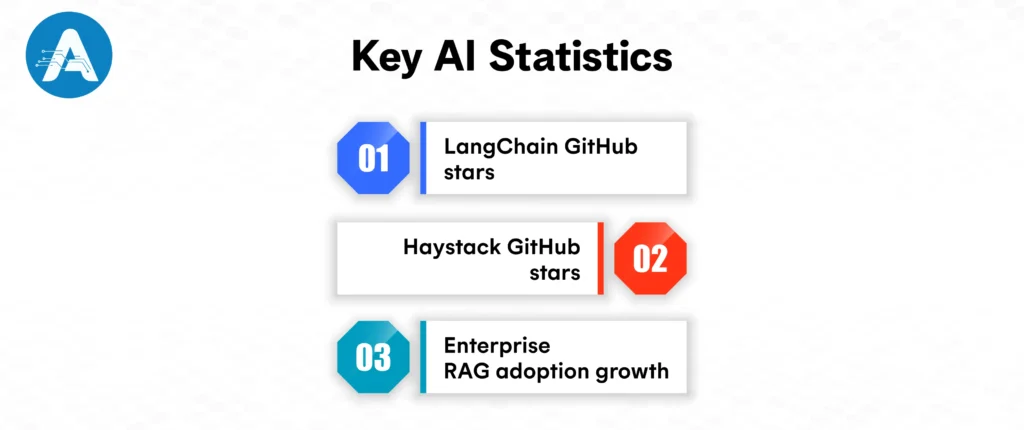
- LangChain GitHub stars: 123,000 approximately
- Haystack GitHub stars: Over 20,000
- Enterprise RAG adoption growth: CAGR of 38.4% or as high as 49.1% between 2025 and 2030.
LangChain has gained immense popularity among developers, supported by a large and active community on GitHub. In contrast, Haystack is widely trusted by enterprises for building reliable, document-focused AI systems.
For an AI application developer, this highlights an important insight: choosing the right framework depends on whether you prioritize community support and flexibility (LangChain) or enterprise-grade reliability (Haystack).
In short, LangChain dominates developer mindshare, while Haystack dominates enterprise trust and real-world applications.
Best Practices from Real AI Projects
The most effective AI solutions often come from a practical, hybrid approach rather than relying on a single framework. Successful projects combine the strengths of different tools to achieve both accuracy and flexibility.
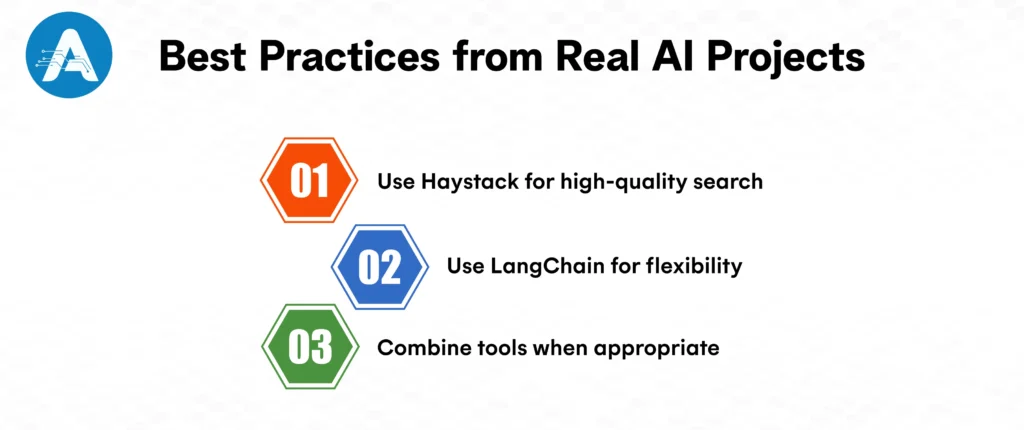
- Use Haystack for high-quality search: When precise, document-focused results are essential, Haystack Search Engine delivers reliable performance, which is why enterprises trust it for real-world applications.
- Use LangChain for flexibility: For projects requiring dynamic workflows, multi-step reasoning, or enhanced user interactions, LangChain provides the adaptability and community support needed to innovate.
- Combine tools when appropriate: Many AI applications integrate both frameworks using Haystack for accurate data retrieval and LangChain to orchestrate responses and manage interactions.
The key takeaway is that AI isn’t about choosing sides; it’s about choosing what works best for each project. The principle remains the same: combine accuracy with flexibility for optimal results.
Final Thoughts on Haystack vs LangChain
There is no one-size-fits-all winner when comparing Haystack and LangChain, as each framework excels in different areas. LangChain is known for its innovation, speed, and ability to support experimentation, making it ideal for projects that require flexibility and rapid prototyping. In contrast, Haystackstands out for its precision, scalability, and enterprise readiness, making it the preferred choice for large-scale, reliable search and document-focused applications.
Furthermore, choosing the right framework depends on several factors, including project size, data complexity, team expertise, and long-term maintenance goals. Smaller prototypes or experimental projects may benefit from LangChain, which is easier to get started with and allows for flexibility and rapid development.
On the other hand, larger, document-focused systems that require accuracy, scalability, and enterprise-level reliability are better suited for Haystack. Ultimately, the decision should align with the specific needs of your project, balancing flexibility, precision, and the resources available for development and maintenance.
With tech titans like Jack Dorsey, Elon Musk, and Richard Branson using pivotal moments to spark conversations about new inventions, Deepinder Goyal’s recent appearance on a popular podcast, where he was seen wearing a peculiar gadget on his temple, has emerged as a fascinating case study. What could have otherwise been a routine discussion has escalated into a full-blown phenomenon, not based on what was said but based on what was worn: a fancy gadget made of metal, which has since gone public with a name, Temple, launched by Deepinder Goyal himself. Its impact was immediate. Viral memes, widespread discussions, skepticism among medical professionals, and growing curiosity across the global community created an organic wave of attention that no traditional marketing campaign could have achieved.
However, beneath all the social commotion, one question arises: Can such viral occurrences serve as an effective platform for marketing innovative designs offered by AI technology, even those still at the experimental level? This blog will unpack the ways through which viral marketing can be an influential platform for influencing the discussion surrounding AI-enhanced technology.
Everyone Had the Same Question: How Temple Took Over the Internet
During an episode of a podcast hosted by Raj Shamani, Zomato CEO Deepinder Goyal was noticed not for making a corporate announcement, but for an unusual device clipped to the back of his ear. The audience automatically began to focus on it as the video began to roll.
Social media was flooded with guesses:
- Was it a next-generation health sensor?
- A neural interface?
- A miniaturized medical device?
With the curiosity building, the media has helped shed light on the confusion: “The device, called Temple, is an experimental wearable that tracks changes in blood flow to the brain in real time. This data correlates to the health and function of the brain and the effects of aging.”
This piques curiosity because the wearable that tracks health indicators is already among the leading technologies in the personal technology front, but brain-related wearables have not seen significant advancements.
It is this organic act of discovery, before a formal product launch, launch event, or advertising campaign, that exemplifies what marketers refer to as “earned media,” that is, publicity that is created, rather than purchased, through consumer-generated buzz.
Temple: Hype or Innovation? A Closer Look at the Device
Before we can fully grasp the implications of this in terms of marketing, there is a need to highlight what Temple is in a very brief manner:
- It’s a wearables experiment designed for the continuous measurement of blood flow to the brain, a function found in very few wearables currently on the market.
- Goyal’s work revolves around the technology that is substantiated through the “Gravity Ageing Hypothesis,” which suggests that the force of gravity could have an impact on the circulation of blood in the body, ultimately contributing to the
- The initial response has been skeptical by some doctors, being termed unproven scientifically, and with calls not to get too carried away, while an ex-AIIMS doctor has termed it as having no scientific standing.
Worth noting is the fact that Temple is not yet a commercial product. In fact, Temple is still in the testing phase. However, it managed to draw the attention of the world prior to the official marketing and release.
This one-of-a-kind circumstance, in which a prototype takes center stage, proves to be both an opportunity and a challenge for AI developers.
Why Going Viral Works So Well for Tech Brands
1. They Turn Curiosity into Awareness
A defining trait of the viral moment is how it converts unintended details into headlines.
Goyal didn’t appear on the podcast to hawk Temple. He didn’t declare a launch date. And the device on his wrist wasn’t the topic at hand, but that didn’t stop anyone from noticing it. The result? Conversation across social media, blogs, forums, and news outlets-all free of paid advertising.
Conventional marketing would spend thousands on:
- TV spots
- Advertisements on the internet
- PR campaigns
- Influencer tie-ins
Yet Temple managed to pull off organic reach simply by being on someone’s head during a video that went viral. Viral attention is essentially user-generated marketing run on curiosity.
This is a clever tactic because people are fundamentally curious about what they don’t know, particularly when the things they don’t know revolve around technology and the human body.
2. They Encourage Community Involvement and Discussion
Viral moments spark discussion, both positive and negative. “The Temple tool had exactly that kind of effect,” Ray Kelly, the NYPD’s police commissioner, explained: “It helped
- It was described as “fascinating” and “wild” by tech cognoscenti and startup entrepreneurs, which can only be described as laudatory talk that further adds to its innovative quality in the device.
- But there was a valid concern raised by medical professionals about a lack of proof and scientific validation.
This two-sided conversation keeps the topic in the news longer than a formal ad campaign would. Both critics and supporters of the topic are participating in the long-tail conversations.
3. They Position Leaders as Forward-Thinkers
By donning Temple, Goyal made, or made himself to appear, as:
- A visionary with experience in innovative wearable technology projects
- A leader who is not afraid to speak out about radical thoughts
- The founder is willing to be open about his own use of the experimental technology
“Being tied to the story of AI is an amazing branding experience, especially if you are involved in AI innovation. Your personal brand gets linked to the story of the innovation that is AI.”
This stylistic choice has a connection with tech giants who display their technological prowess at conferences by showing how they use gadgets in their personal lives, but in this situation, a wearable experience had a similar impact without purpose, ironically making it rather interesting.
What Temple Teaches Us About AI Marketing
Therefore, what kind of lessons can AI innovators draw from this viral moment? Here are the actionable marketing pointers:
1. Let Authentic Context Drive Exposure
Visibility at Temple was part of a natural event rather than a planned advertisement. Being genuine is more effective than a staged demo. Viewers tend to believe naturally occurring content more readily than advertisements. This is simply because it is less planned.
How to Put This into Practice:
- It is good to encourage thought leaders in your company to use your technology in public situations.
- Share authentic, unscripted stories because they have more impact than a commercial.
- “Create stories out of user stories instead of specs.”
Authenticity breeds shareable moments.
2. Engage in a Conversation Even When it is Critical
Not all attention is necessarily good attention. In fact, the Temple device was greeted with scepticism by doctors and vigorous debate over its validity.
However, the negative or critical reporting is also a conversation, and conversation drives attention.
How to Put This into Practice:
- Ready your brand to respond to critics in a respectful manner
- As a response to skepticism, it should be seen as an avenue to clarify and educate.
- Use debates to create thought leadership content or Q&A articles
Criticism is not a setback. When handled openly, it builds credibility.
3. Blending Storytelling with Technology
The tale of Temple is more than a gadget because the story revolves around a theory, curiosity, and a vision for human health. The tale added meaning to the technology.
How to Put This into Practice:
- To make your innovation more meaningful and memorable, frame it in the context of an interesting story that includes the problem, vision, and
- Don’t use technical talk in a vacuum. Connect the tech to a human experience.
- Use storytelling to convert features to impact.
It’s the Stories That Make Technology Memorable.
4. Create Buzz Across Multiple Channels
The Temple viral video was shared across:
- Podcasts
- Social Media Reactions
- Social
- Tech news and blog sites
- Meme subculture and conversation speak
Each of the channels added to it their own element. Also importantly, a viral event is not spread through an advertising campaign but is itself shared through multiple channels.
How to Put This into Practice
- Your tech should be represented in public forums, talk show programs, forums, and communities.
- User-generated content related to your innovation should be encouraged.
- Monitor organic mentions and engage if necessary.
Different channels will give you an even bigger audience.
Possible Risks and Ethical Concerns
Viral marketing, although highly effective, also has its dangers:
1. When Hype Outruns Evidence
There have even been questions raised over Temple’s scientific basis, with medical professionals advising people not to regard it as proven technology.
It is important for firms in AI and health technology to avoid making promises about their products. Viral media attention without any tangible results can lead to negative effects in the future.
What Works Best: The best balance to strike: Curiosity must be tempered by caveats.
2. Misinterpretation by the Public
Memes and jokes are entertaining, but they may misrepresent the true intention of the technology. This is crucial in ensuring the right perception of the technology among the general public.
What Works Best: Take advantage of “viral” events to communicate and educate, not just entertain.
3. Privacy and Ethics in AI Wearables
Brands have the responsibility of being open regarding privacy and the use of health-related data when they market their offerings involving AI and wearable technology.
What Works Best: Keep commitments to uphold privacy at the forefront and make them readily understandable, especially during times of heightened public interest.
What This Means for the Future of AI
What the Temple phenomenon underlines is that viral moments will lift AI innovations into mainstream discussion, even if the complete product is still an idea. It contravenes traditional marketing wisdom and opens up organic doors to brand shaping.
The lesson for AI innovators is a simple one:
Visibility doesn’t require perfection; it requires presence.
By being part of the conversation, even incidentally, your technology can reach further than it can through contrived marketing.
Conclusion
Though Deepinder Goyal’s Temple gadget might still be in its experimental stages, with its scientific claims open to interpretation, its journey into the limelight proves an important fact: curiosity-driven humans remain the best marketing tools.
Whether it’s a revolutionary AI algorithm, a wearable tech product, or a health tech device, never forget the power of actual moments, and moments that intrigue, surprise, and propel conversations can mean more than advertising budgets totaling billions of dollars.
In the social media era and the hyper-connected audience, the most successful campaigns begin with a question, and not a pitch.
Launching a fully functional online store in just a few hours might have sounded impossible a few years ago. But today, in 2025, it has become a reality, thanks to the powerful evolution of Shopify AI website builder tools that simplify everything from design to content creation to sales optimization.
As the digital world rapidly transforms, the adoption of AI tools in design and development has skyrocketed. Recent studies show that over 93% of web designers now use AI tools for various tasks, whether it’s generating layouts, improving images, creating copy, or optimizing page designs. Even more interesting is the shift in consumer mindset: more than half of clients now trust AI-assisted website design for their e-commerce projects.
As someone who has personally seen this shift, I can confidently say that building a polished Shopify store no longer demands weeks of coding, expensive design resources, or endless trial–and–error cycles. You can now use website builder AI platforms that take your prompt, analyze your product, and literally auto-create your entire store structure within minutes. Whether you want to create pages, generate SEO-rich descriptions, improve visuals, or even import product details from marketplaces, AI builders now do it all.
These AI website builders don’t just save time; they empower you to bring creativity to life without requiring any technical expertise.
So today, we’ll dive deep into the Top 7 Best Shopify AI Website Builder Solutions 2025, explore how they make store building easier, and understand why collaborating with a trusted AI development company can take your e-commerce success even further.
Before that, let’s understand why AI builders are booming and how to choose the best AI website generator for your store.
Why Shopify AI Website Builders Are in High Demand in 2026
The demand for AI-driven tools has exploded, and for good reasons. Previously, creating a website required detailed planning, content writing, page structuring, and numerous design revisions. That process often stretched over weeks or even months.
Today, AI website builders, website builder AI, and AI website builders can do this in minutes.
From my personal experience, using AI for website design has changed how Shopify stores operate. AI tools don’t just build structure; they create meaningful content, generate SEO-friendly product descriptions, optimize page flow, and even suggest smart layouts that improve conversion rates.
Here are some reasons why AI builders are becoming essential:
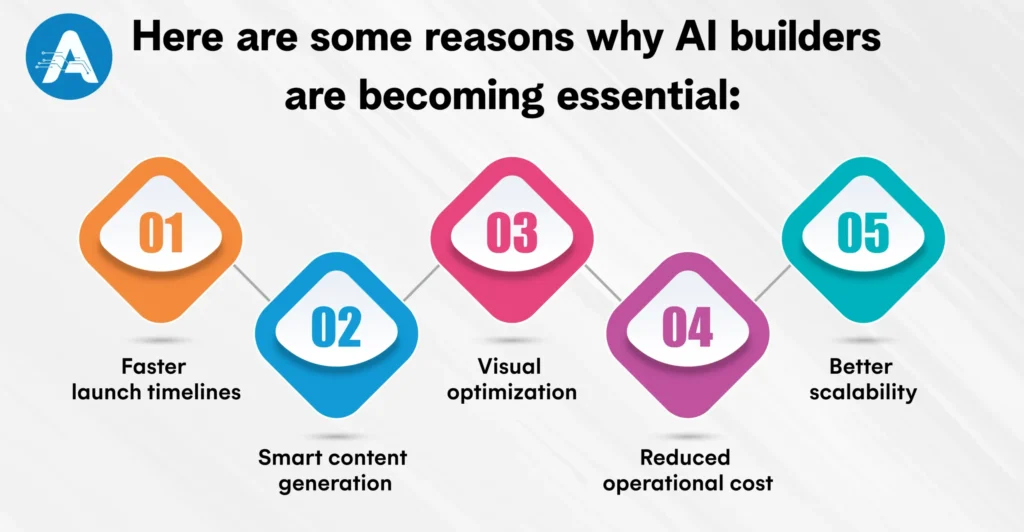
- Faster launch timelines- Instead of spending 20–30 hours on product pages, some AI builders can generate entire pages using just a product URL.
- Smart content generation-AI writes product descriptions, meta tags, blog ideas, and category content using built-in natural language intelligence.
- Visual optimization– AI enhances product images, removes backgrounds, creates banners, and suggests layouts that align with modern UI/UX standards.
- Reduced operational cost– You don’t need multiple designers, developers, and writers when AI can automate most of the creation process.
- Better scalability-When launching multiple products quickly, AI saves enormous time.
AI for website development has become a normal practice, not just a trend. This is why many business owners and online entrepreneurs now rely on the best AI website generator, AI site generator, and AI website creator instead of building everything from scratch.
How to Choose the Best Shopify AI Website Builder
Choosing the right Shopify AI website builder can save you hours of work and help create a high-converting online store. If you are planning to build your Shopify store quickly, here’s how to pick the best Shopify AI website builder for your needs.
- Choose tools that work seamlessly with Shopify stores so you can manage products, checkout, inventory, and more without extra hassle something even an experienced AI development company focuses on when building scalable e-commerce solutions.
- Look for AI features like AI-generated layouts, product descriptions, page creation, responsive design, SEO support, and intelligent content generation. Tools with capabilities related to AI website development, such as AI website builder, AI create website, AI website generator, and free AI website builder, can make building your store much easier.
- Make sure the tool allows you to get a fully functional Shopify store up and running quickly, sometimes in just a few hours or even minutes.
- Pick a solution that lets you customize designs, manage larger product catalogues, and scale your store as your business grows.
- Check real-world performance by reviewing testimonials or case studies to see whether the tool improves conversion rates, saves time, and produces high-quality content.
- Consider affordability and free options, especially if you are starting small or want to test an AI website builder without spending too much upfront.
Top 7 Best Shopify AI Website Builder Solutions 2026
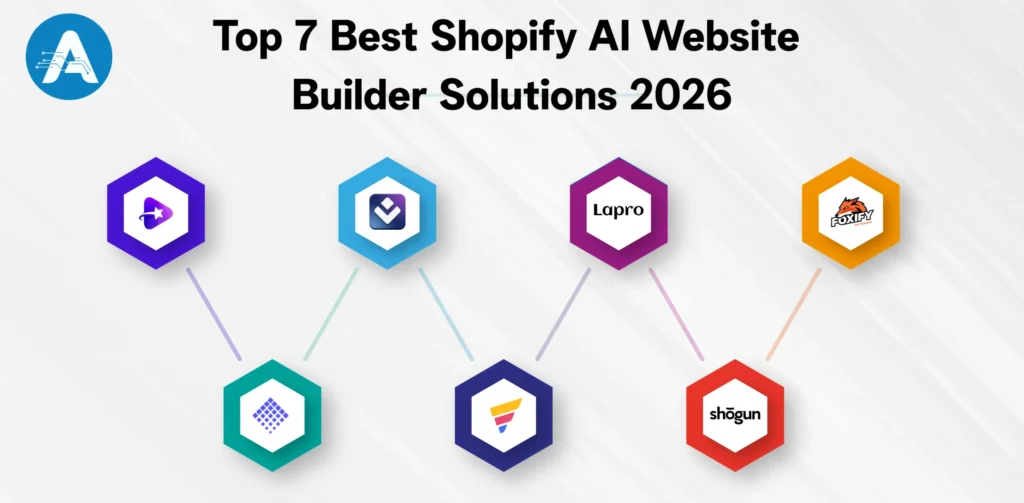
1. Shopify Magic
Shopify Magic is not a standalone builder, but it’s one of the most accessible AI tools for website design and content within Shopify itself. It helps with product descriptions, content creation, blog ideas, basic layouts, and image improvements without adding extra apps. You will find all inside your Shopify dashboard. This AI website builder is apt for Shopify users who prefer simple AI support without installing third-party tools. All its advanced features have helped stores reduce content writing time by almost 25 per cent.
Key Features
- Automated descriptions
- SEO-friendly text generation
- blog topic ideas,
- basic image edits
- smart content suggestions
If you are looking for a simple AI website builder with built-in features at no extra cost, then Shopify Magic is ideal for effortless store management.
2. Atlas AI Store Builder
Atlas AI is one of the most popular Shopify AI website builder tools because it can create a complete store in less than a minute using only a product link. It collects product data, builds layouts, writes persuasive descriptions, improves images, and sets up the entire website automatically. It works like a full AI website generator for fast Shopify launches. Furthermore, it is ideal for beginners, drop shippers, and busy entrepreneurs who want an instant store without manual designing. Many users say it saves hours of work per product.
Key Features
- AI-generated layouts
- Optimized product pages
- Improved product images
- SEO ready content
- Automatic store setup
- Instant product import from Amazon or AliExpress
If you want the fastest way to launch a conversion-ready Shopify store with almost no effort, Atlas AI gives you complete automation from a single prompt.
3. Lapro.io
Lapro.io mixes AI layouts, conversion-focused copywriting, and instant testing. It is made especially for e-commerce brands and drop shippers. It can create complete product pages in a few seconds by pulling product data from marketplaces like Amazon and AliExpress. It is apt for small and mid-sized brands, drop shippers, and entrepreneurs who want fast product launches. After switching to its templates, many users report improved sales.
Key Features
- Multilingual AI product pages
- Strong conversion templates
- AI-powered layouts
- Built-in testing and optimization tools
- Many users report improved sales after switching to its templates
If you care more about speed and conversions than deep custom design, this tool is perfect for launching products or testing niches quickly.
4. Foxify
Foxify is an affordable yet powerful Shopify AI website builder. It is known for clean templates, AI support, and a simple drag-and-drop editor that suits new and budget-friendly store owners. It is apt for small businesses, new entrepreneurs, and budget-conscious sellers.
Key Features:
- Ready-made templates
- AI-generated copy
- Easy drag and drop editing
- Mobile-friendly layouts
- Sticky add to cart features
- Low-cost plans
If you want stylish pages without spending too much, Foxify gives you great value with AI support.
5. PageFly
PageFly is one of the most widely used AI page builders for Shopify. It is great for creating fast landing pages for promotions, seasonal offers, and product launches. It is simple, beginner-friendly, and very quick to work with. It is ideal for stores that need quick landing pages for campaigns or new product releases.
Key Features:
- AI-assisted templates
- Simple drag and drop editor
- Countdown timers
- Reusable blocks
- Mobile-optimized pages
- Smooth Shopify integration
If you want clean landing pages in minutes without any coding, PageFly makes the process extremely easy.
6. GemPages AI
GemPages AI offers both creativity and intelligent automation. You get full drag and drop control along with AI suggestions for layouts, page sections, and sales-focused designs. It is ideal for people who want freedom in designing while still getting support from AI. It is apt for store owners who want flexible design options with smart AI guidance.
Key Features
- AI-assisted page layouts
- Conversion-focused elements
- Simple drag and drop editor
- SEO friendly blocks
- Mobile optimization
- Split testing tools
If you love designing but want AI to help with ideas, structure, and performance, this tool gives you the perfect balance.
7. Shogun Page Builder
Shogun is loved by advanced users because it combines AI assistance with deep customization. You get complete design freedom, reusable page sections, very fast loading pages, and powerful testing features. It is ideal for large stores, scaling brands, or advanced sellers who need strong design control.
Key Features
- AI layout suggestions
- Custom page building
- Advanced testing
- Reusable design blocks
- Performance optimization
- Full creative control
If you want enterprise-level customization with AI guidance to improve conversions, Shogun is a strong choice.
Best Shopify AI Website Builder Tools (2026)
| AI Website Builder | Best For | Key Features | Why choose it |
| Shopify Magic | Shopify users who want simple, built-in AI tools | AI descriptions, SEO content, blog ideas, basic layouts, image edits, and content suggestions | No extra apps needed, reduces content creation time by 25%, easiest AI tool inside Shopify |
| Atlas AI Store Builder | Beginners, dropshippers, busy entrepreneurs | AI store layouts, optimized pages, improved images, SEO content, instant product import, and automatic store build | Fastest full Shopify AI website builder, creates complete stores in under a minute, ideal for fast launches |
| Lapro.io | Small–mid brands, dropshippers, fast product testing | Multilingual product pages, conversion templates, AI layouts, A/B testing, optimization tools | Builds pages in seconds, boosts conversions, great for rapid niche testing |
| Foxify | Budget-friendly merchants, small | Ready templates, AI copy, drag-and-drop editor | Affordable, easy to use, stylish pages with AI assistance |
PageFly | Stores needing quick landing pages for campaigns | AI templates, drag-and-drop editor, countdown timers, reusable blocks, and mobile optimization | Ideal for promotions, seasonal sales, and fast landing page creation with no coding |
| GemPages AI | Store owners who want design freedom + AI help | AI layout ideas, conversion elements, drag-and-drop editor, SEO blocks, mobile optimization, split testing | Balanced AI + creativity, perfect for flexible and high-performance designs |
| Shogun Page Builder | Large stores, scaling brands, and advanced customization | AI suggestions, advanced page building, reusable blocks, performance optimization, A/B testing | Enterprise-level design control, deep customization, and powerful for high-growth stores |
Every coin has two sides, and the same applies to Shopify AI website builders. They offer powerful advantages, but they also come with certain limitations that you should be aware of before relying on them fully.
Limitations of AI Website Builders for Shopify
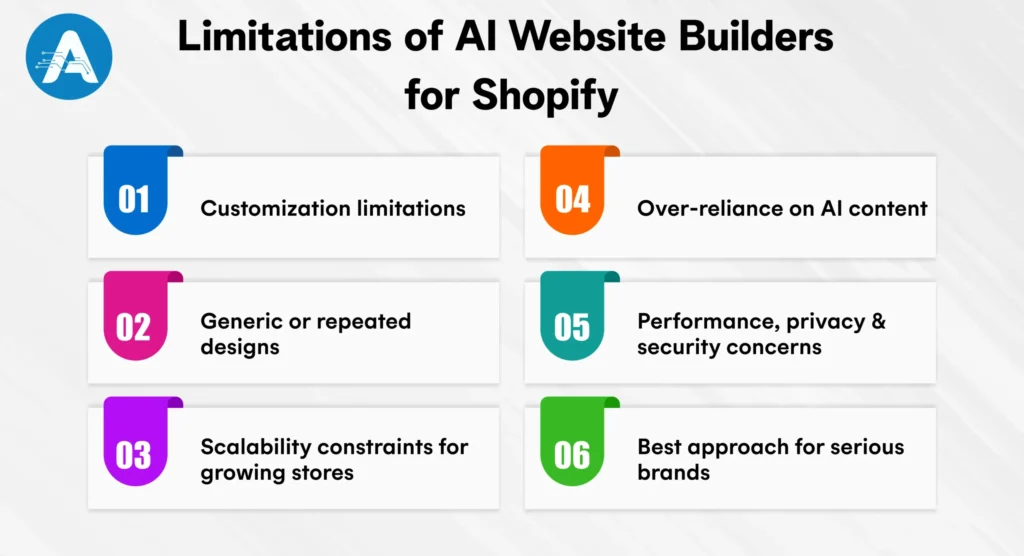
- Customization limitations – AI layouts may not fully match your brand identity, and you may still need manual custom CSS or JS to refine the design.
- Generic or repeated designs – Basic AI builders often generate layouts that look similar, which can reduce brand uniqueness and hurt long-term SEO differentiation.
- Scalability constraints for growing stores – Shops needing complex filters, custom checkout flows, or unique UI may outgrow AI builders and require an experienced AI application development team.
- Over-reliance on AI content – AI-generated product pages and SEO text can sometimes feel generic, requiring manual improvement for stronger ranking and conversions.
- Performance, privacy, and security concerns – Some AI builders depend on third-party tools, which may affect site speed, data control, or long-term stability.
- Best approach for serious brands – AI website builders are excellent starting points, but many businesses later enhance or rebuild their store with professional AI app development services to achieve full customization and better performance.
Wrapping Up
As someone who works on content that actually drives business results, you can see how AI is completely changing the e-commerce game. The gap between your ideas and your execution is getting smaller every day. Now, you can literally wake up with a store idea in the morning and have your Shopify site live by afternoon. What once needed big budgets, long timelines, and full teams is now possible in just a few hours with the right AI website builder or even an AI website builder free option that provides a quick starting point for new sellers.
When you explore the top Shopify AI website builder options for 2025, you will see that tools like Lapro.io and Shopify Magic are great for e-commerce-focused workflows and fast content creation. Builders such as Wix ADI with Shopify, Hostinger, 10Web, and Framer also deliver strong value depending on whether you want quick design, more creative control, or a budget-friendly launch. Each AI builder solves a different need, so the best choice depends on your launch speed and customization goals.
As your store grows, you may eventually want deeper customization, better automation, and advanced integrations. This is where working with an AI application developer or choosing AI application development services can take your Shopify store to the next level by improving performance, adding custom features, and integrating AI-driven automation.