
Are you curious about how people like you and me can create an artificial intelligence startup that actually works in real life? Trust me, you don’t need to be a tech expert or come from a big company to get started. AI today is easier to use, more practical, and more business-friendly than ever before, giving every entrepreneur a chance to turn simple ideas into powerful real-world solutions.
This blog will help you gain clearer insights into what artificial intelligence is, how to select the right types of AI, how artificial intelligence coding functions, and how to build a strong, scalable business model.
Understanding Artificial Intelligence for today’s businesses
Before learning how to create artificial intelligence, it’s essential to understand what artificial intelligence truly means for modern businesses. Today, AI is not just a technology-based concept; rather, it is a practical tool that helps companies make faster decisions, enhance efficiency, and unlock new revenue opportunities.
Artificial intelligence refers to computer systems that can analyze data, learn from patterns, make decisions, and take intelligent actions. These systems use algorithms and software that allow machines to recognize trends, predict outcomes, and automate tasks that previously needed human involvement. In simple words, when you ask what is artificial intelligence or what is an AI is, you’re asking how machines can think, learn, and act with intelligence.
Furthermore, AI is also one of the fastest-growing markets in the world. In 2025, the global artificial intelligence market is estimated to be between $638 billion and $750 billion, showing massive demand across industries. Some reports expect AI to grow to $2.4 trillion to $3.5 trillion by the early 2030s as more businesses depend on machine learning, automation, and natural language processing.
Nowadays, AI is no longer optional. It has become essential for businesses that want to stay competitive. For entrepreneurs, AI technology offers a perfect opportunity to innovate and build meaningful AI products that solve real problems.
We can observe that businesses are not just talking about AI anymore; they’re actively integrating it into their daily operations, using it for everything from customer support and workflow automation to smarter data-driven decision-making.
Moreover, AI appears in many forms that businesses rely on today, including:
- Rule-based automation that follows predefined logic.
- Machine learning models that continuously learn and improve from data.
- Generative AI systems that create text, images, ideas, and designs.
- Computer vision and robotics that interpret and interact with the physical environment.
Understanding which type of AI fits your business goals is essential because it shapes your artificial intelligence strategy, product development, and technical foundation.
You may also want to know the AI Voice Generator Platform Development
A Simple Step-by-Step Way to Create an Artificial Intelligence Startup
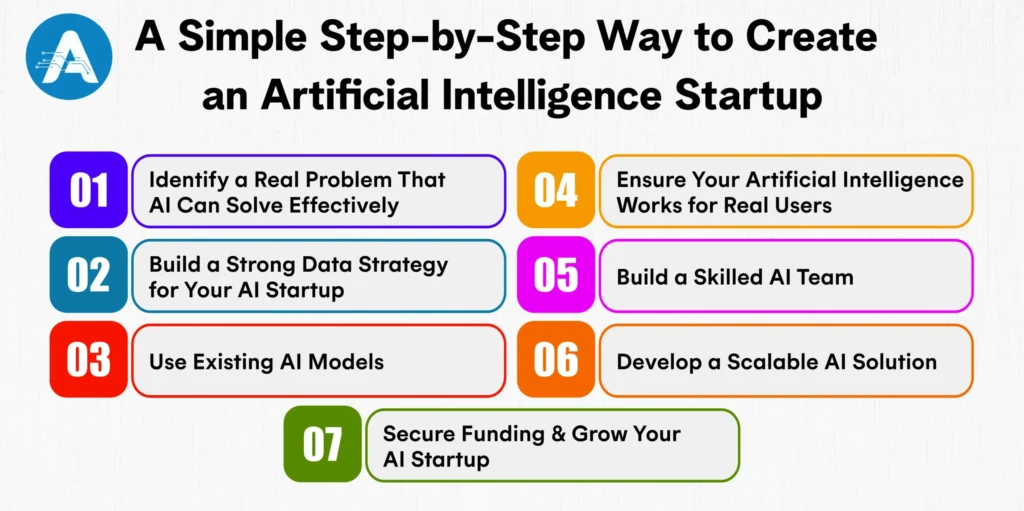
1) Identify a Real Problem That AI Can Solve Effectively
Before you create an artificial intelligence solution, it’s important to check whether the problem trulyrequires AI. Many people rush toward AI because it feels exciting, but real success comes from choosing a genuine problem that customers already find difficult or time-consuming.
To keep your idea practical, ask yourself:
- Will artificial intelligence make this task quicker, simpler, or more accurate?
- Can a machine learn from the data available and perform better than a human?
- Are people or businesses already paying for manual, inefficient, or outdated methods?
If the answer is “yes”, then you are on the right track.
For example, if your enterprise lacks the tools or processing capacity required to run advanced AI systems, then Neysa solves this gap by offering ready-to-use AI infrastructure that your organisation can adopt immediately.
2) Build a Strong Data Strategy for Your AI Startup
Data is the fuel that powers every artificial intelligence system.
Before you start building anything with artificial intelligence code, you must be clear about how your data will be collected, structured, and used.
Start by asking yourself:
- What type of data does my AI model need to learn and deliver accurate results?
- Do I already have this data, or do I need to collect, purchase, or request it from partners?
- Is the data clean, labelled, and organized so that machine learning with AI can understand it easily?
- Am I using this data in an ethical and legally compliant way?
Even the most advanced AI machine learning model will fail if the data is messy or incomplete. High-quality data leads to high-quality predictions; poor data leads to unreliable outcomes.
No need to worry; if you don’t have a lot of data at the beginning, most AI startups start this way. By employing the following sources, you can still build a good data foundation:
- Data partnerships with companies that already gather the information you need
- Public or open-source datasets that can be used for training your initial models
- Synthetic data, which is becoming a powerful option when real data is limited, sensitive, or expensive to access
For instance, suppose you want to build an AI HR screening tool
To train it, you need résumés, job descriptions, and past hiring results.
However, as a new startup, you may not yet have a large dataset. Here’s how you can still get the data you need:
- Work with small recruitment agencies to access anonymized resumes
- Use open-source datasets that include sample résumés
- Create synthetic résumés to help your model learn basic patterns
- Collect data from your early clients and improve your model over time
Many successful AI HR tools started with small amounts of data and achieved steady improvement over time.
3) Use Existing AI Models
Most AI startups today don’t create AI models from scratch, as developing your own large model takes a lot of money, time, and computing power, and sometimes doesn’t give you any real business advantage.
Instead of building everything from scratch, most successful AI startups choose smarter and faster options that include:
- Employ ready-made AI models from OpenAI, Anthropic, Google, or Meta through simple API calls
- Customize these models with your own domain data so they become more accurate for your business needs
- Mix both methods, where you use open-source models and add your own features to create something unique
This is also the stage where you begin working with artificial intelligence codes.
You’ll write simple scripts to connect your product with APIs, fine-tune the models, or integrate AI directly into your app or platform.
For instance, if your startup requires a fully custom model like computer vision, recommendation engines, or speech recognition, then you’ll likely use frameworks such as:
- PyTorch
- TensorFlow
- Other AI/ML libraries designed for model training and deployment
These tools help you build smaller, specialized models without the extreme cost of building a full, large-scale system from scratch.
4) Ensure Your Artificial Intelligence Works for Real Users
At this stage, many AI startups face challenges. Artificial Intelligence is not only a smart technology, but it also makes work easier for users.
Before investing a significant amount of time or money, ensure that you test your AI solution with real users by starting small.
- A clear problem that your artificial intelligence solution is addressing
- A working prototype or MVP that users can test and interact with
- Early feedback from real users to find out what works and what needs improvement
Your AI doesn’t need to be perfect at this stage. The key is to see how users engage with it and use their feedback to improve your AI model, features, and overall product experience.
For instance, suppose you are developing an AI-powered customer support chatbot. Instead of spending months building the perfect system, you launch a basic version for a small group of users or businesses.
Early feedback might show you:
- The chatbot handles simple questions effectively
- It struggles with more complex queries
- Its responses could be faster or sound more natural
This input allows you to improve your AI machine learning model gradually, making it more accurate and useful before rolling it out to a larger audience.
5) Build a Skilled AI Team
You require a team of skilled individuals to create a successful AI startup :
- AI researchers or machine learning engineers to design and improve models
- Product managers who understand business challenges and user needs
- AI app developers to integrate models into real products and make them user-friendly
Finding skilled AI talent can be challenging. Many startups get started by working with contractors, hiring remote AI developers, or partnering with research groups until they can grow a full in-house team.
For instance, Artisan AI is a startup that builds digital AI colleagues to automate business workflows.
In the beginning, the founders worked with remote AI developers and contractors to create their initial prototypes. This allowed them to test ideas quickly without hiring a full in-house team.
6) Develop a Scalable AI Solution:
Running an AI startup requires strong infrastructure because AI systems are resource-intensive. You’ll need to plan for:
- GPUs or cloud computing power to train and run AI models efficiently
- Data storage and processing for handling large datasets safely and quickly
- Model deployment and monitoring to make sure your AI works reliably in real-world conditions
- Secure APIs and services to connect your AI models with your product and users
It’s important to have a clear strategy for your infrastructure. Many startups use cloud providers like AWS, Azure, or Google Cloud. Others use edge computing for faster processing or a hybrid approach that combines both cloud and on-site resources.
For example, when OpenAI launched ChatGPT, they relied heavily on cloud computing and GPU clusters to train and deploy their models. This scalable setup allowed them to handle millions of users simultaneously while maintaining high performance.
Smaller AI startups can follow a similar approach on a smaller scale. Planning scalable infrastructure from the start allows your AI startup to grow smoothly, support more users, and expand AI capabilities without major technical roadblocks.
7) Secure Funding and Grow Your AI Startup
AI startups are one of the fastest-growing categories in tech today, attracting attention from investors, enterprises, and the media.
To gain traction, focus on proving your product works and showing real user adoption. This helps you attract funding and grow faster.
For example, Anthropic, an AI research startup, raised hundreds of millions within months of launching.
- OpenAI partnered with Microsoft to scale enterprise adoption of its AI models.
- Early traction in the form of users, partnerships, or pilot deployments helps investors trust your vision and supports long-term growth.
Which Skills and Tools Are Essential for an AI Startup?
If you’re creating an artificial intelligence startup, you’ll regularly work with a mix of technical skills and practical tools, including:
- Python and artificial intelligence libraries such as TensorFlow and PyTorch for building and training AI models
- Cloud platforms like AWS, Azure, or Google Cloud to run and scale AI systems
- APIs for generative AI to add features like text, image, or content generation
- Front-end or mobile development skills are especially important if you’re an AI app developer building user-facing products
- Data engineering and pipeline management to collect, clean, and prepare data for machine learning with AI
Beyond tools, businesses must understand the artificial intelligence characteristics that allow AI to learn, adapt, and deliver real value, which are as follows:
- Adaptability: Artificial intelligence systems get better over time by learning from new data and real-world use.
- Learning from data: AI uses past information to make quicker, smarter, and more accurate decisions.
- Pattern recognition: AI can spot trends and behaviors in large amounts of data that people often miss.
- Decision automation: Artificial intelligence helps businesses move faster by automatically handling routine and data-based decisions with better accuracy.
You may also want to know the best AI for Writing Code
How to Monetize an Artificial Intelligence Startup
Once you create an artificial intelligence solution, the next big question is how your startup will make money. Most successful artificial intelligence businesses follow proven monetization models that align with how AI is used in real life.
Here are some common and effective ways AI startups generate revenue:
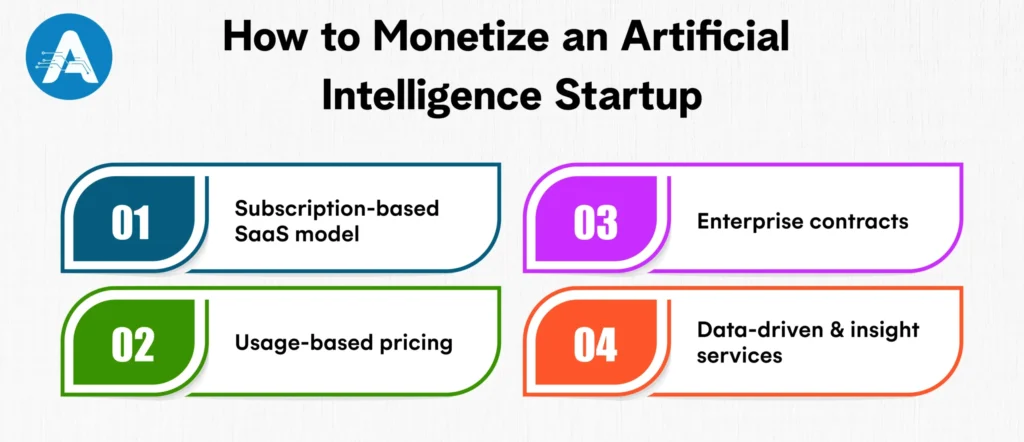
Subscription-based SaaS model
Many AI startups charge a monthly or yearly subscription for access to their artificial intelligence platform. This works well for AI tools used regularly, such as automation software, analytics dashboards, or AI-powered business applications built by an AI app developer.
Usage-based pricing
In this model, customers pay based on how much they use the AI system. This could include charges per API call, AI model usage, or computing time. It’s a popular choice for companies offering AI services through artificial intelligence codes and APIs, especially when customers have varying usage needs.
Enterprise contracts
Larger organizations often require customized AI solutions. An AI development company can generate revenue through long-term enterprise contracts by delivering tailored artificial intelligence systems, seamless integrations, and ongoing support to meet specific business needs.
Data-driven and insight services
Some AI startups monetize by offering advanced insights, predictions, and analytics powered by AI machine learning and machine learning with AI. Businesses pay a premium for smarter decision-making based on AI-generated intelligence.
Choosing the right monetization strategy depends on what AI is in your product, how it works, the types of AI you use, and the value it delivers to customers. For an AI application developer, having a clear and well-defined revenue model helps the startup grow sustainably while attracting long-term clients and investor confidence.
Moving Forward with Your Artificial Intelligence Vision
If you’ve reached this point, you’re already thinking seriously about how to create an artificial intelligence solution and turn it into a real business opportunity.
Artificial intelligence is no longer just a technology trend; it’s a powerful business enabler. You don’t need to build the next global AI platform to succeed. What matters is identifying the right problem, understanding what is in real business terms, and using AI artificial intelligence to deliver practical value.
Whether you’re exploringAI machine learning, choosing the right types of AI, or working with an AI development company that offers AI application development services, success depends on smart planning and clear execution.
Imagine building an AI-powered product that helps businesses save time, reduce costs, or make better decisions. That’s the real potential of AI startups today, creating meaningful impact through well-designed artificial intelligence solutions.
Your journey starts now, with the right idea, the right strategy, and the right use of AI technology.