
As businesses grow, managing day-to-day operations becomes increasingly complex. Finance, HR, inventory, sales, and customer data are often scattered across multiple systems, making it difficult to access the right information at the right time. To overcome this challenge, many organizations rely on enterprise resource planning (ERP) systems to bring all critical business functions onto a single platform.
However, even the most advanced ERP platforms often feel powerful yet complicated. Users struggle with complex dashboards, slow data retrieval, and inefficient workflows, which can limit adoption and productivity. At the same time, today’s fast-moving digital world demands instant responses, real-time insights, and seamless access to information for customers, employees, and leadership teams alike.
This is where an ERP AI Chatbot becomes a true game-changer. By combining artificial intelligence with ERP systems, these chatbots simplify how users interact with enterprise data. Instead of navigating multiple screens and reports, users can simply ask questions and receive accurate, real-time answers, making ERP systems more intuitive, responsive, and business-friendly.
According to 2025 industry research, over 70% of ERP vendors have integrated AI-enabled capabilities, highlighting the rapid adoption of intelligent technologies in ERP platforms. Businesses that utilize AI-powered ERP Chatbot tools can make decisions more quickly and work more efficiently, as they receive information faster. Many organizations are also utilizing chatbots for everyday internal tasks, making ERP systems easier and more natural to use.
In this blog, we will explore how ERP chatbot works, why they matter for modern enterprises, and how they are reshaping the way businesses interact with enterprise resource planning systems to operate smarter and faster.
Understanding ERP in the Modern Business Environment
Before understanding how chatbots transform ERP systems, it is important to first understand what an ERP system is and why it matters in today’s business environment.
An enterprise resource planning (ERP) system is the backbone of an organization. It integrates core business processes such as finance, human resources, supply chain, inventory, procurement, sales, and customer management into one centralized platform. The primary goal of ERP software is to eliminate data silos, reduce manual work, and enable smoother, more efficient operations across departments.
Whether a business uses ERP software to manage payroll, track inventory, process invoices, or forecast demand, the objective remains the same: centralized data, better visibility, and streamlined decision-making. With the rise of online ERP software and cloud-based ERP systems, organizations can now access critical business information anytime and from anywhere.
You may also want to know the Best AI Companies
User Experience Challenges in Traditional ERP Platforms
Despite their power, many ERP platforms are often perceived as complex and difficult to navigate. Employees may need extensive training just to perform simple tasks like checking reports or retrieving basic data. Even experienced users can find daily ERP interactions time-consuming.
Some common challenges include:
- Interfaces that are difficult to understand and navigate
- Too many screens are required to find a single piece of information
- Reliance on IT teams for simple reports and routine queries
- Delays in accessing real-time, actionable insights
As businesses grow and operations become more dynamic, these limitations can slow productivity and reduce overall ERP adoption. This is why ERP systems must evolve to become more user-friendly and responsive.
The Rise of ERP AI Chatbots
An ERP AI Chatbot is an intelligent virtual assistant developed using advanced AI application development services that connects directly with an enterprise resource planning system. Instead of navigating multiple dashboards and modules, users can interact with the ERP platform through simple, conversational language, making everyday tasks faster and easier.
Just like messaging apps or voice assistants used in daily life, ERP AI chatbots bring the same level of simplicity to ERP online systems. With the support of AI application development services, users can ask routine questions about sales performance, overdue invoices, inventory availability in a specific warehouse, or payroll status and receive instant, accurate answers. The chatbot understands each request, retrieves real-time data from the ERP system, and delivers responses seamlessly without the need to switch between different ERP modules.
ERP AI Chatbot Categories for Business Operations
ERP AI chatbots can be grouped into several types based on how businesses use them within enterprise resource planning systems.
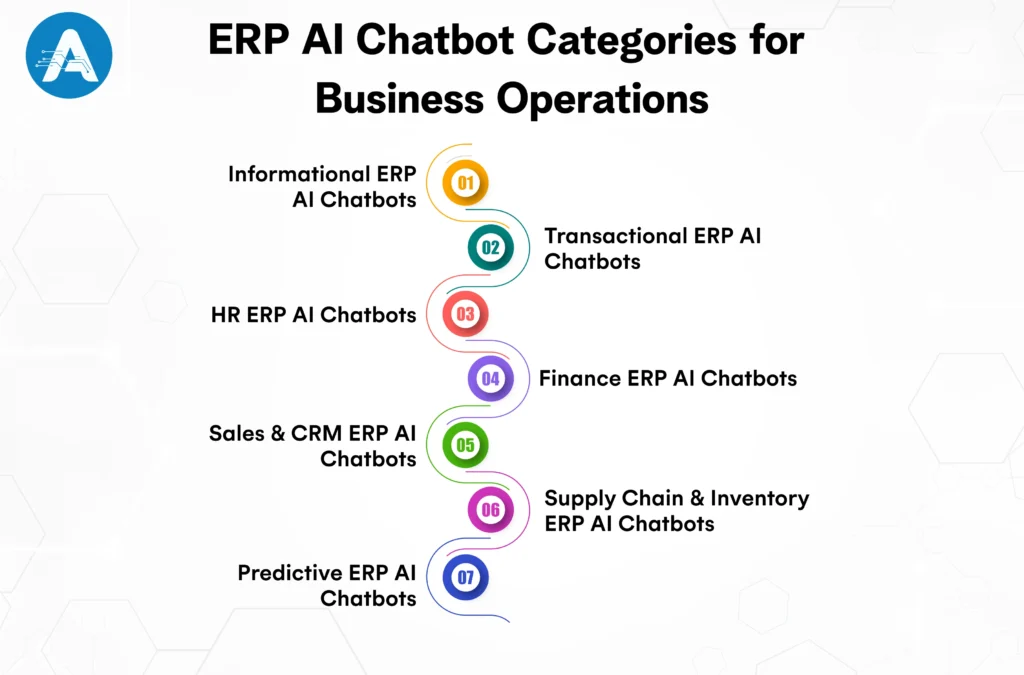
Informational ERP AI Chatbots
These chatbots answer common ERP questions by providing real-time data from finance, HR, sales, inventory, and procurement modules.
Transactional ERP AI Chatbots
These chatbots allow users to complete ERP tasks through chat, such as creating purchase orders, approving requests, or updating records.
HR ERP AI Chatbots
These chatbots support HR activities like payroll inquiries, leave balance checks, attendance tracking, and employee onboarding.
Finance ERP AI Chatbots
Designed for accounting teams, these chatbots help track invoices, payments, budgets, and financial reports directly from the ERP system.
Sales and CRM ERP AI Chatbots
These chatbots provide instant access to customer details, order status, pricing, and sales performance data.
Supply Chain and Inventory ERP AI Chatbots
Used in operations and logistics, these chatbots show stock levels, warehouse availability, order tracking, and supplier information.
Predictive ERP AI Chatbots
Advanced ERP AI chatbots use historical ERP data to deliver forecasts, trends, and insights for smarter planning and decision-making.
Essential Features of ERP AI Chatbots for Businesses
An Artificial Intelligence app development company plays a crucial role in building ERP AI chatbots that align with business goals and integrate seamlessly with enterprise systems. These chatbots combine intelligent automation, real-time ERP data access, and secure workflows to help organizations improve efficiency, decision-making, and overall system usability.
- Natural language understanding: Allows interaction with ERP systems using simple, conversational language instead of technical commands or complex queries.
- Real-time ERP data access: Retrieves live information from finance, HR, sales, inventory, and other ERP modules without delays.
- Multi-module integration: Connects seamlessly with multiple ERP modules to deliver a unified and consistent view of business data.
- Task and transaction execution: Enables actions like approvals, record updates, request creation, and submissions directly through chat.
- Role-based access control: Ensures secure ERP usage by allowing access only to data and actions permitted by assigned roles.
- AI-driven insights and recommendations: Analyze ERP data to identify trends, exceptions, and insights that support better business decisions.
- 24/7 availability provides: Uninterrupted access to ERP information and support, regardless of time or location.
- Omnichannel support: Works across web platforms, mobile devices, and collaboration tools for flexible ERP access.
- Scalability and customization: Adapt easily to business growth and can be tailored to specific ERP workflows and requirements.
- Secure and compliant framework: Maintains data security, audit logs, and compliance with enterprise standards and regulations.
How ERP AI Chatbots Make ERP Systems Easier to Use
ERP AI chatbots act as a bridge between users and complex ERP platforms. They do not replace ERP systems but enhance them by making interactions simpler and more intuitive. By enabling conversational access to ERP data, these chatbots reduce the effort required to navigate dashboards and reports, allowing faster access to critical business information.
This approach offers key advantages that benefit businesses in the following ways:
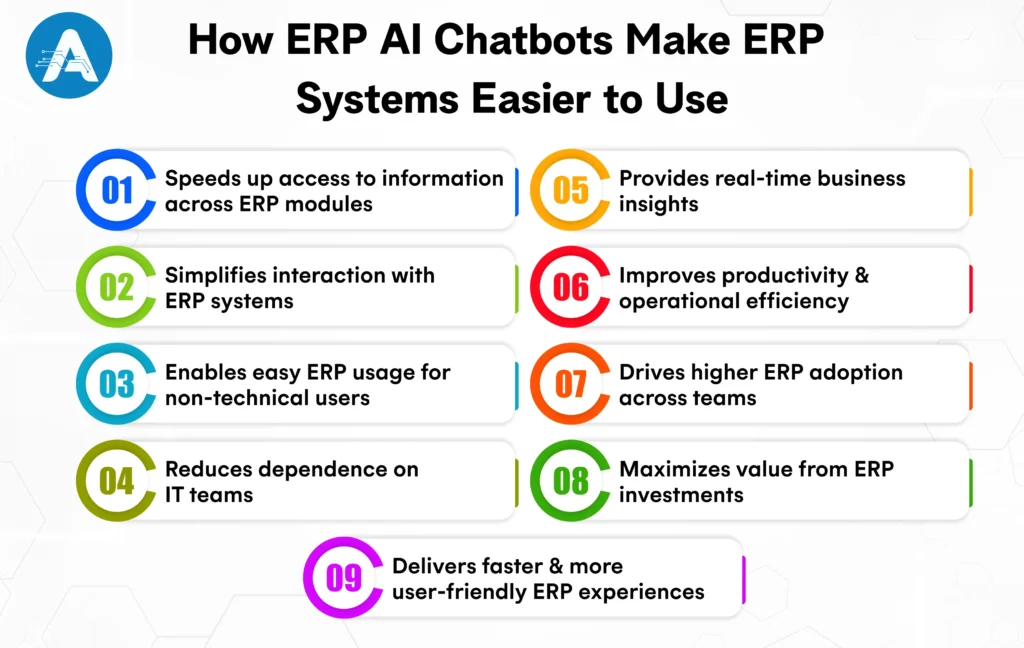
- Speeds up access to information across ERP modules: Users can quickly retrieve data from finance, HR, sales, and inventory without navigating multiple screens or reports.
- Simplifies interaction with ERP systems: Conversational access reduces interface complexity and makes daily ERP tasks easier to perform.
- Enables easy ERP usage for non-technical users: ERP functions can be accessed without extensive training or deep technical knowledge.
- Reduces dependence on IT teams: Routine data queries and report generation can be handled directly without IT involvement.
- Provides real-time business insights: Instant access to live data supports quicker and more informed business decisions.
- Improves productivity and operational efficiency: Less time spent on system navigation allows teams to focus on higher-value work.
- Drives higher ERP adoption across teams: Simpler access encourages regular usage across departments and roles.
- Maximizes value from ERP investments: Better usability ensures organizations fully leverage their enterprise resource planning systems
- Delivers faster and more user-friendly ERP experiences: This is especially valuable for businesses using cloud-based ERP systems where speed and accessibility matter most.
For example, imagine a retail company that relies on an ERP online system to track inventory and sales performance.
Without an ERP AI chatbot, managers spend valuable time navigating multiple screens and exporting reports just to get basic insights. This slows down decision-making and increases day-to-day operational effort.
With an ERP AI chatbot, the same information is available through simple, conversational queries. Teams can access real-time data faster, reduce manual work, and focus more on important business priorities.
As a result, everyday operations become smoother and more efficient.
How to Develop an ERP AI Chatbot for Businesses
Developing an ERP AI chatbot involves integrating artificial intelligence with enterprise resource planning systems to create a seamless, efficient, and user-friendly conversational interface. An experienced AI application developer can help design, build, and integrate the chatbot seamlessly with your ERP platform. Below are the key steps involved in the development process.
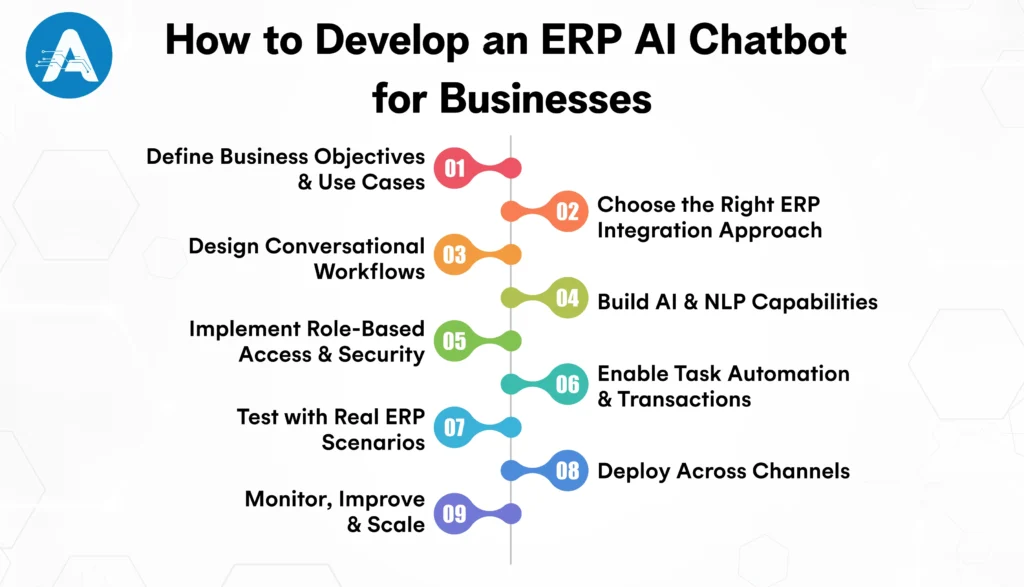
1. Define Business Objectives and Use Cases
Start by identifying what the ERP AI chatbot should achieve. Common use cases include answering ERP queries, generating reports, automating approvals, or handling HR and finance requests. Clear objectives ensure the chatbot aligns with business needs.
2. Choose the Right ERP Integration Approach
The chatbot must connect securely with the ERP system using APIs or middleware. A skilled AI application developer ensures real-time access to ERP modules such as finance, HR, inventory, sales, and procurement without disrupting existing workflows.
3. Design Conversational Workflows
Create simple, intuitive conversation flows that mirror actual business questions. The chatbot should understand natural language queries and guide users smoothly through ERP-related tasks.
4. Build AI and NLP Capabilities
Implement natural language processing (NLP) and machine learning to help the chatbot accurately understand user intent, context, and variations in questions. This ensures precise data retrieval and meaningful interactions.
5. Implement Role-Based Access and Security
Ensure the ERP AI chatbot respects ERP user roles and permissions. This step protects sensitive business data and maintains compliance across departments.
6. Enable Task Automation and Transactions
Configure the chatbot to perform actions such as approvals, record updates, request creation, and status checks, in addition to providing instant answers to queries.
7. Test with Real ERP Scenarios
Conduct thorough testing using real-world ERP queries and workflows. This step validates accuracy, performance, and security before deployment.
8. Deploy Across Channels
Make the ERP AI chatbot accessible on web portals, mobile apps, and collaboration platforms to provide easy access for all teams.
9. Monitor, Improve, and Scale
Continuously monitor the chatbot’s performance, refine responses based on user feedback, and expand features as business needs evolve to ensure the ERP AI chatbot remains effective and up to date.
How ERP AI Chatbots Are Shaping the Future
The future of ERP AI chatbots is looking very promising as AI technology keeps improving and business needs keep changing. These chatbots will become smarter, more proactive, and easier to use, helping teams get insights faster. They will also automate routine tasks, personalize responses for different users, and work seamlessly with cloud ERP systems.
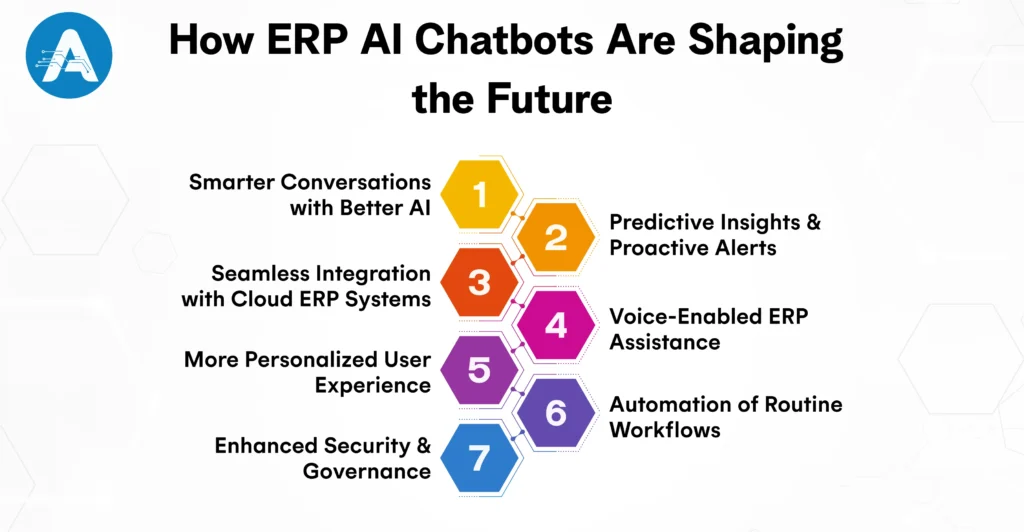
Smarter Conversations with Better AI
ERP chatbots will become even more intelligent, understanding complex questions and context more accurately. Instead of simple replies, they will offer deeper insights, predictions, and suggestions.
Predictive Insights and Proactive Alerts
Rather than waiting for you to ask, future chatbots will proactively surface important insights, such as warnings about low inventory, cash flow issues, or upcoming deadlines, before you even notice them.
Seamless Integration with Cloud ERP Systems
As more businesses move to cloud-based ERP systems, chatbots will work more smoothly with mobile and remote workflows. You’ll be able to get updates and take action from anywhere, anytime.
Voice-Enabled ERP Assistance
Voice control is becoming more common in everyday tools. Soon, you may be able to talk to your ERP AI chatbot just like you talk to a voice assistant, making data access even faster and hands-free.
More Personalized User Experience
Chatbots will learn individual user habits and preferences, tailoring responses based on roles, past behavior, and work patterns. For example, a finance manager and supply chain lead will get different insights based on what they need most.
Automation of Routine Workflows
Beyond answering questions, future ERP AI chatbots will automate simple workflows, like approving purchase requests, creating invoices, or scheduling tasks, saving even more time.
Enhanced Security and Governance
As chatbots become more capable, they will also come with stronger security features, ensuring sensitive ERP data remains protected while enabling flexible access.
What makes Artoon the best choice for your ERP AI chatbot?
When it comes to choosing a partner for your best ERP AI chatbot, you want more than just technical expertise. You need a team that understands your business, your processes, and your goals. Artoon combines deep knowledge of enterprise resource planning systemswith advanced AI and natural language capabilities, ensuring your ERP AI chatbot works seamlessly with your workflows and delivers accurate, actionable insights.
Our AI experts create custom solutions that fit your industry, your data, and your needs, whether you are using cloud-based ERPsystemsor anonline ERP software platform. Our focus is on making your life easier by designing chatbots that are intuitive and simple to use, helping your team get answers quickly, reduce repetitive work, and increase adoption.
Moreover, you will see measurable results such as faster access to insights, reduced manual effort, and improved operational efficiency. Security and reliability are a priority, protecting your sensitive ERP data with enterprise-grade safeguards while providing ongoing support to help your chatbot evolve as your business grows. This ensures that your ERP AI chatbot becomes a strategic tool for smarter business operations and a true partner in your success.
If you are looking for the right partner to implement your ERP AI chatbot, contact the services of Artoon and take the first step toward smarter business operations.
Artificial Intelligence (AI) is not just something for the future; it is already shaping how we live and work. From apps that suggest your next favorite show to tools that help doctors predict illnesses, AI is everywhere. However, the reality is that AI can accomplish amazing things, yet it can also create serious problems if not managed carefully. Many organizations have successfully built AI models that transformed their business, while others have struggled because governance was not part of the plan. This leads to an important question every organization must ask: how do you build an artificial intelligence governance framework that keeps AI smart, safe, and trustworthy?
This article provides step-by-step guidance, supported by real-world situations and practical insights, to enhance your understanding.
What AI Governance Is and Why It Matters
AI governance is the set of rules, processes, and guidelines that help organizations use artificial intelligence in a responsible and controlled way. For an AI application developer, AI governance provides a clear framework to ensure systems are fair, reliable, secure, and aligned with business goals. It clearly defines how AI should be built, used, monitored, and improved over time.
It ensures that AI systems are fair, reliable, secure, and aligned with business goals. Simply put, AI governance defines how AI should be built, used, monitored, and improved over time.
Governance may sound like a complex corporate term, but at its core, it is about making sure AI behaves the way it is intended to. AI systems often make decisions that directly affect people, money, and reputations. Without proper governance, AI can produce biased outcomes, misuse data, or make decisions that are difficult to explain. These issues can lead to legal risks, loss of customer trust, and long-term damage to a company’s reputation.
This is why AI governance matters. Studies by McKinsey and MIT estimate that 70–85% of AI initiatives fail, mainly because of poor data quality, unclear objectives, and limited executive support.
Strong AI governance helps organizations avoid these risks while building trust and confidence in their AI systems. It ensures AI is transparent, ethical, and dependable. It also clarifies who is responsible for AI decisions, how risks are managed, and how performance is regularly reviewed.
Good AI governance ensures that AI is:
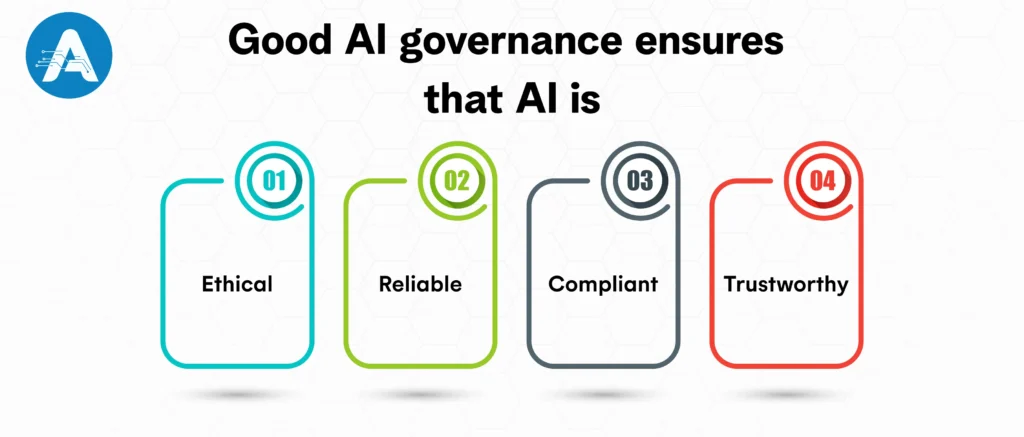
- Ethical – treats everyone fairly and reduces bias
- Reliable – delivers accurate and consistent results
- Compliant – follows laws and regulations
- Trustworthy – builds confidence among teams, customers, and stakeholders
For example, while working with a fintech startup on an AI-based loan approval system, early testing showed the model was rejecting qualified applicants due to hidden data bias. By introducing AI governance early, false rejections were reduced by 30%, and trust was built with both customers and regulators.
In short, with the right governance in place, businesses can innovate with confidence knowing their AI systems are responsible, transparent, and built for long-term success.
You may also want to know about ERP AI Chatbots
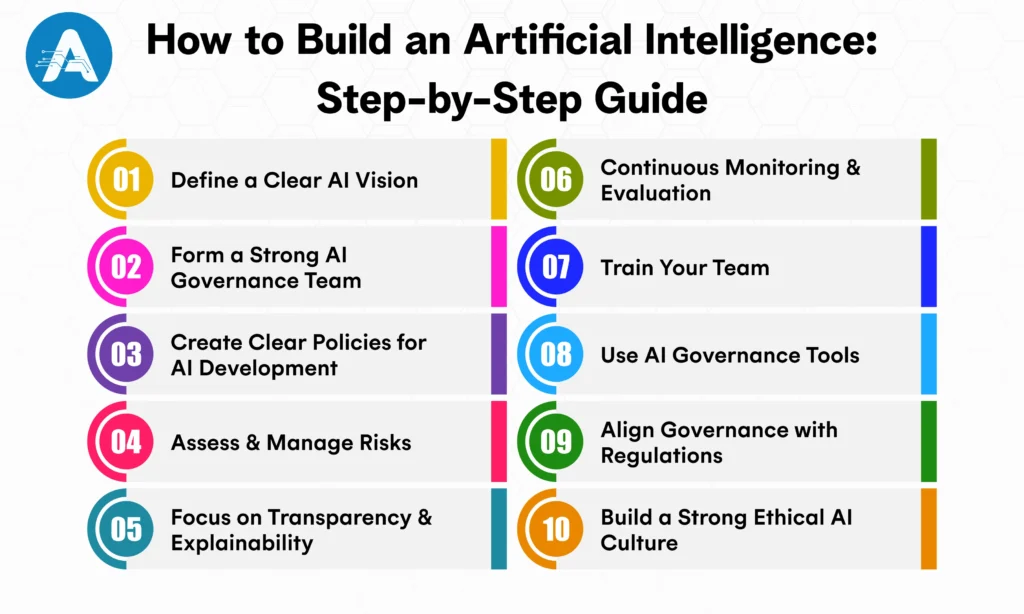
How to Build an Artificial Intelligence: Step-by-Step Guide
This step-by-step guide explains how to build an artificial intelligence system, from planning and data preparation to model development and deployment. It helps businesses and beginners understand the AI building process clearly and practically.
Step 1: Define a Clear AI Vision
Before you build an artificial intelligence, you need a clear purpose. Ask yourself:
- What problem do you want your AI to solve?
- What ethical values will guide your AI decisions?
- How will you measure AI success?
For example, a healthcare company wanted to build an AI system for patient diagnosis. Their vision was clear and practical: AI should support doctors, not replace them, while ensuring safety, transparency, and fairness.
Tips to define your AI vision:
- Make sure your AI supports your business goals
- Involve people from different teams early
- Keep ethics at the center while building AI
Step 2: Form a Strong AI Governance Team
To successfully build an AI model, you need the right people guiding it. Your AI governance team should include:
- Ethics officers to ensure fairness and responsible AI building
- Data scientists to develop and monitor AI models
- Legal experts to manage compliance and regulations
- Business leaders to align AI building with strategy
Example: A fintech company built an AI model for loan approvals. By involving legal, ethics, and business teams, they reduced bias and built customer trust.
Step 3: Create Clear Policies for AI Development
Policies are the foundation of build an artificial intelligence. They define how your AI is built, deployed, and managed. Focus on:
- Data policies: Ensure data quality, privacy, and governance
- Model policies: Set standards for accuracy, fairness, and explainability
- Deployment policies: Plan monitoring, updates, and rollback strategies
- Risk policies: Identify and manage AI risks and failures
For example, when a retail company decided to build an AI app for personalized marketing, clear policies helped prevent bias and protect customer trust. This approach made their AI building process ethical, transparent, and effective.
Step 4: Assess and Manage Risks
AI systems are not perfect, and failures can happen. Risk management helps protect the business from unexpected issues.
- Identify risks such as bias, inaccurate results, and security gaps
- Assess impact on finances, reputation, and daily operations
- Reduce risks through human review, regular audits, and backup processes
For example, Uber’s AI-based pricing system once caused unfair surge pricing. Strong governance and risk controls could have reduced customer backlash and reputational damage.
Step 5: Focus on Transparency and Explainability
AI should not work like a black box. When AI decisions are clear and understandable, trust naturally increases.
- Use models that are easier to interpret whenever possible
- Keep records of AI decisions and actions
- Use dashboards to track performance and fairness
For example, in healthcare, explainable AI helps doctors understand why a patient is marked as high risk, making AI decisions more reliable and accepted.
Step 6: Continuous Monitoring and Evaluation
AI systems change over time, so governance must be ongoing.
- Monitor accuracy, bias, and performance changes
- Update AI models with fresh and relevant data
- Regularly review ethical impact and business outcomes
For example, Companies like Netflix continuously monitor recommendation systems to ensure content remains relevant and fair, showing how AI can be managed responsibly.
Step 7: Train Your Team
AI governance works best when employees understand how AI systems function and make decisions.
Training should focus on:
- Ethical use of AI
- Understanding AI outputs
- Reporting errors, bias, or unexpected behavior
For example, Organizations that invest in AI training often see better adoption and fewer mistakes because employees become active contributors to responsible AI use.
Step 8: Use AI Governance Tools
Technology plays an important role in managing AI governance.
- Track AI model versions and data sources
- Check systems for bias and fairness
- Monitor performance and compliance
For example, AI governance tools from leading technology providers help make build an artificial intelligence safer, clearer, and more controlled.
Step 9: Align Governance with Regulations
AI regulations are evolving quickly, and businesses must stay prepared.
- Follow major AI laws and guidelines, such as the EU AI Act, which focuses on risk assessment for high-risk AI systems
- Pay attention to regulations like the US Algorithmic Accountability Act that promote fairness and transparency
- Build compliance into AI governance from the start instead of handling it at the last moment
For example, when governance and compliance work together, organizations can avoid legal risks and move forward with confidence.
Step 10: Build a Strong Ethical AI Culture
AI governance goes beyond policies and processes. It is also about building the right mindset across the organization.
Encourage teams to think critically and ask simple but important questions:
- Is this AI decision fair and unbiased?
- Could it negatively affect users or customers?
- Who is responsible for the outcome of this AI decision?
For example, A strong ethical culture supports technical governance and helps build long-term trust in AI systems.
The Role of AI Governance in the Building of AI
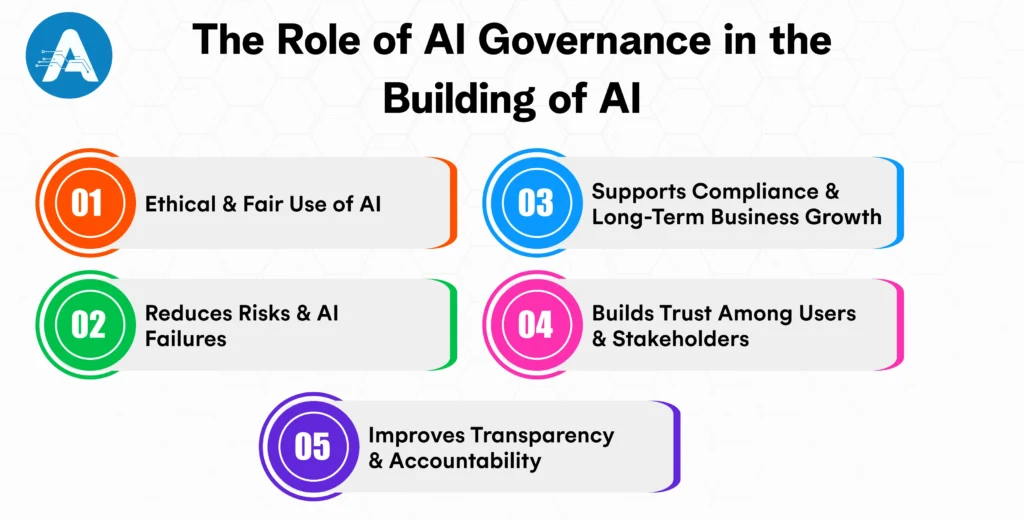
For an AI development company, AI governance guides the building of AI by setting clear rules for responsible and ethical development. It helps reduce risks, improve transparency, and ensure AI systems are trustworthy.
Ethical and Fair Use of AI
An AI governance framework helps ensure that AI systems treat everyone fairly. It reduces the risk of bias, discrimination, and unfair outcomes by establishing clear rules for data use, model design, and decision-making. This is especially important in areas like hiring, lending, healthcare, and customer service, where AI decisions can directly affect people’s lives.
Reduces Risks and AI Failures
AI governance helps identify and manage risks such as incorrect predictions, system failures, data misuse, or security issues. By implementing controls, reviews, and monitoring, organisations can identify problems early and prevent costly mistakes that could impact operations or brand image.
Supports Compliance and Long-Term Business Growth
AI regulations are increasing worldwide. An AI governance framework helps organizations stay compliant with current and future laws while aligning AI initiatives with business goals and values. This allows companies to innovate safely, scale AI faster, and gain a long-term competitive advantage.
Builds Trust Among Users and Stakeholders
Trust is critical for AI adoption. When AI systems are governed properly, customers, employees, and partners feel more confident using them. Governance ensures transparency, clear ownership, and responsible use of AI, which strengthens trust and protects the organization’s reputation.
Improves Transparency and Accountability
With a governance framework, AI decisions are easier to understand and explain. It clearly defines who is responsible for AI outcomes and how decisions are made. This transparency makes it easier to review AI behavior, handle complaints, and ensure accountability across teams.
Principles for How to Build an AI with Strong Governance
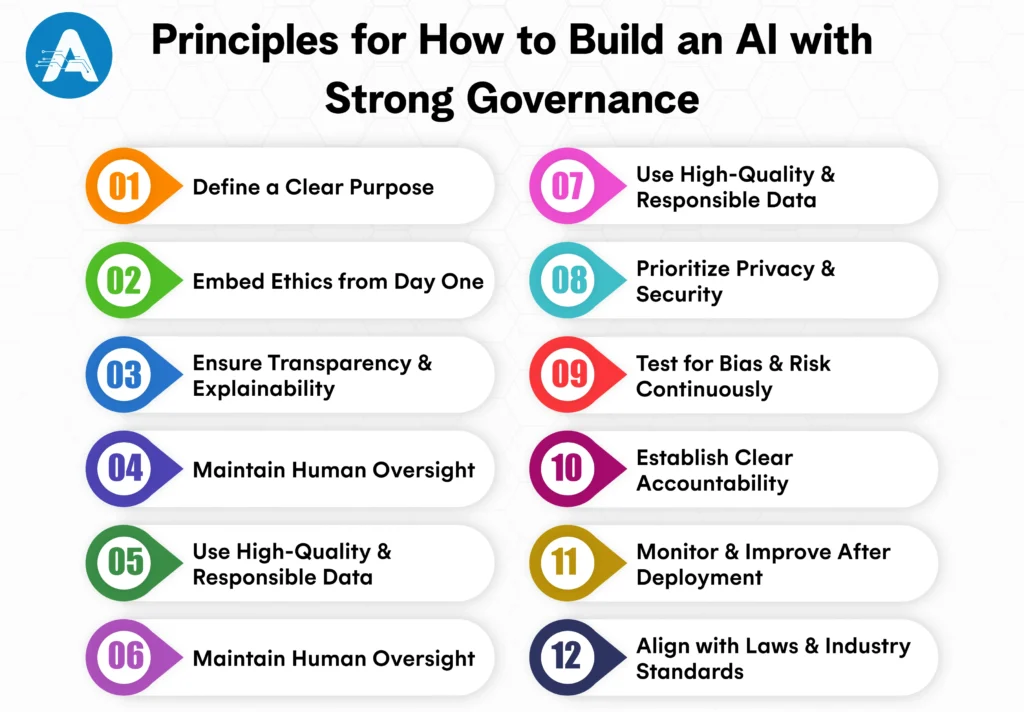
AI application development services should focus on building solutions that are ethical, transparent, and aligned with business goals. Strong governance ensures data privacy, fairness, and human oversight throughout the AI development lifecycle. This approach builds trust, reduces risk, and enables responsible, scalable AI adoption.
Define a Clear Purpose
When building an AI system, it is important to start with a clearly defined purpose. The AI should address a specific business or user problem and support meaningful outcomes. Its goals must align with organizational values and ethical standards. A well-defined purpose helps guide development decisions and prevents misuse or unnecessary complexity.
Embed Ethics from Day One
Ethics should be integrated into AI development from the very beginning, not added later. Fairness, inclusivity, and responsible decision-making must guide data selection and model design. Addressing ethical risks early helps reduce bias and builds trust. This approach ensures the AI system behaves responsibly throughout its lifecycle.
Ensure Transparency and Explainability
AI systems should be designed so their decisions can be understood by users and stakeholders. Transparency helps explain how outcomes are generated and why certain decisions are made. This is especially important in high-impact areas such as healthcare or finance. Explainable AI builds confidence and strengthens governance.
Maintain Human Oversight
AI should assist human decision-making rather than replace accountability. Clear processes must be in place for human review and intervention when needed. Critical decisions should always involve human judgment. This ensures ethical control and prevents over-reliance on automated systems.
Use High-Quality and Responsible Data
The effectiveness of AI depends heavily on the quality of data used. Data should be accurate, unbiased, and collected through legal and ethical means. Poor-quality or biased data can lead to unreliable and unfair outcomes. Responsible data practices are essential for strong AI governance.
Prioritize Privacy and Security
Protecting user data must be a top priority when building AI systems. Privacy-by-design principles should be embedded throughout the development process. Strong security measures help prevent data breaches and misuse. Compliance with data protection regulations further strengthens trust and governance.
Test for Bias and Risk Continuously
AI governance does not end after deployment. Regular testing is required to identify bias, performance issues, and emerging risks. As data and usage patterns change, models must be reassessed and improved. Continuous evaluation ensures the AI remains fair, reliable, and safe.
Establish Clear Accountability
Clear ownership of AI systems is essential for effective governance. Organizations must define who is responsible for AI decisions, performance, and failures. Accountability ensures quicker issue resolution and better risk management. It also reinforces trust among users and stakeholders.
Monitor and Improve After Deployment
Once deployed, AI systems must be continuously monitored to ensure consistent performance. Changes in data or environment can impact accuracy and fairness. Regular updates and improvements help maintain alignment with governance standards. Ongoing monitoring supports long-term success.
Align with Laws and Industry Standards
AI systems must comply with applicable laws, regulations, and industry guidelines. Legal alignment reduces operational and reputational risks. Industry standards also promote ethical and responsible AI use. Compliance helps organizations build trust and scale AI solutions confidently.
The Future of AI Governance in Build an Artificial Intelligence
The future of AI governance will focus on balancing innovation with responsibility as AI becomes central to business and society. Governments and organizations will introduce clearer regulations, global standards, and ethical frameworks to support safe and responsible AI development without limiting growth.
AI governance will increasingly prioritize transparency, explainability, and accountability, especially when building high-risk AI systems. Organizations will be expected to clearly document how AI models are built, trained, and deployed. Regular audits and impact assessments will become a standard part of AI application development services.
Another major shift will be toward continuous and automated AI governance. Instead of one-time compliance checks, businesses will use monitoring tools to track bias, security, and performance in real time. This ensures AI systems remain compliant, fair, and reliable as they evolve.
Overall, the future of AI governance will be more human-centric and collaborative. Strong human oversight, cross-functional teams, and cooperation between regulators, developers, and businesses will be essential. This approach will build trust, enable responsible AI adoption, and support long-term, sustainable AI growth.
Reasons to Choose Artoon Solutions for Your AI Governance Needs
Partnering with Artoon ensures a structured and reliable approach when you build an artificial intelligenceor work on AI projects. Artoon combines deep expertise in AI development with strong governance frameworks, helping organizations reduce risks, ensure ethical practices, and maintain transparency throughout the AI lifecycle.
Moreover, with Artoon, businesses can confidently build an AI, knowing that every model, app, or system follows best practices for compliance, accountability, and performance. From designing AI solutions to monitoring and improving them, Artoon provides the guidance and tools needed for safe, trustworthy, and scalable AI.
Furthermore, choosing Artoon for AI governance ensures your AI initiatives are not only innovative but also aligned with business goals, ethical standards, and regulatory requirements, turning AI projects into long-term value for your organization.
Wrapping Up
AI governance is no longer optional; it is a critical part of building responsible and successful AI systems. A strong governance framework helps reduce risks, improve transparency, and ensure AI solutions remain ethical, reliable, and aligned with business goals. It also builds trust among users, customers, and stakeholders while supporting long-term growth.
By embedding governance into every stage of AI development, organizations can innovate with confidence. The right approach to AI governance ensures that artificial intelligence is not only powerful but also safe, compliant, and built for long-term success.
Launching a fully functional online store in just a few hours might have sounded impossible a few years ago. But today, in 2025, it has become a reality, thanks to the powerful evolution of Shopify AI website builder tools that simplify everything from design to content creation to sales optimization.
As the digital world rapidly transforms, the adoption of AI tools in design and development has skyrocketed. Recent studies show that over 93% of web designers now use AI tools for various tasks, whether it’s generating layouts, improving images, creating copy, or optimizing page designs. Even more interesting is the shift in consumer mindset: more than half of clients now trust AI-assisted website design for their e-commerce projects.
As someone who has personally seen this shift, I can confidently say that building a polished Shopify store no longer demands weeks of coding, expensive design resources, or endless trial–and–error cycles. You can now use website builder AI platforms that take your prompt, analyze your product, and literally auto-create your entire store structure within minutes. Whether you want to create pages, generate SEO-rich descriptions, improve visuals, or even import product details from marketplaces, AI builders now do it all.
These AI website builders don’t just save time; they empower you to bring creativity to life without requiring any technical expertise.
So today, we’ll dive deep into the Top 7 Best Shopify AI Website Builder Solutions 2025, explore how they make store building easier, and understand why collaborating with a trusted AI development company can take your e-commerce success even further.
Before that, let’s understand why AI builders are booming and how to choose the best AI website generator for your store.
Why Shopify AI Website Builders Are in High Demand in 2026
The demand for AI-driven tools has exploded, and for good reasons. Previously, creating a website required detailed planning, content writing, page structuring, and numerous design revisions. That process often stretched over weeks or even months.
Today, AI website builders, website builder AI, and AI website builders can do this in minutes.
From my personal experience, using AI for website design has changed how Shopify stores operate. AI tools don’t just build structure; they create meaningful content, generate SEO-friendly product descriptions, optimize page flow, and even suggest smart layouts that improve conversion rates.
Here are some reasons why AI builders are becoming essential:
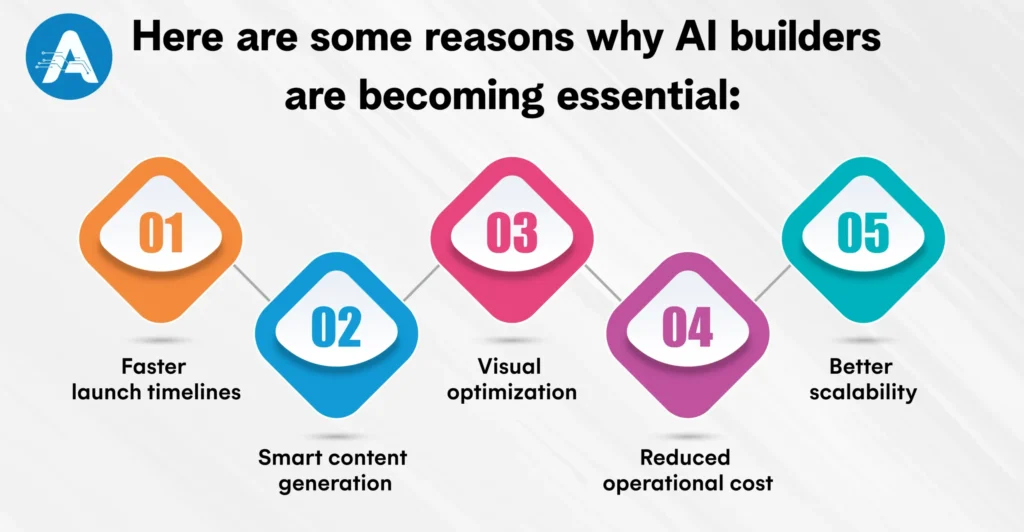
- Faster launch timelines- Instead of spending 20–30 hours on product pages, some AI builders can generate entire pages using just a product URL.
- Smart content generation-AI writes product descriptions, meta tags, blog ideas, and category content using built-in natural language intelligence.
- Visual optimization– AI enhances product images, removes backgrounds, creates banners, and suggests layouts that align with modern UI/UX standards.
- Reduced operational cost– You don’t need multiple designers, developers, and writers when AI can automate most of the creation process.
- Better scalability-When launching multiple products quickly, AI saves enormous time.
AI for website development has become a normal practice, not just a trend. This is why many business owners and online entrepreneurs now rely on the best AI website generator, AI site generator, and AI website creator instead of building everything from scratch.
How to Choose the Best Shopify AI Website Builder
Choosing the right Shopify AI website builder can save you hours of work and help create a high-converting online store. If you are planning to build your Shopify store quickly, here’s how to pick the best Shopify AI website builder for your needs.
- Choose tools that work seamlessly with Shopify stores so you can manage products, checkout, inventory, and more without extra hassle something even an experienced AI development company focuses on when building scalable e-commerce solutions.
- Look for AI features like AI-generated layouts, product descriptions, page creation, responsive design, SEO support, and intelligent content generation. Tools with capabilities related to AI website development, such as AI website builder, AI create website, AI website generator, and free AI website builder, can make building your store much easier.
- Make sure the tool allows you to get a fully functional Shopify store up and running quickly, sometimes in just a few hours or even minutes.
- Pick a solution that lets you customize designs, manage larger product catalogues, and scale your store as your business grows.
- Check real-world performance by reviewing testimonials or case studies to see whether the tool improves conversion rates, saves time, and produces high-quality content.
- Consider affordability and free options, especially if you are starting small or want to test an AI website builder without spending too much upfront.
Top 7 Best Shopify AI Website Builder Solutions 2026
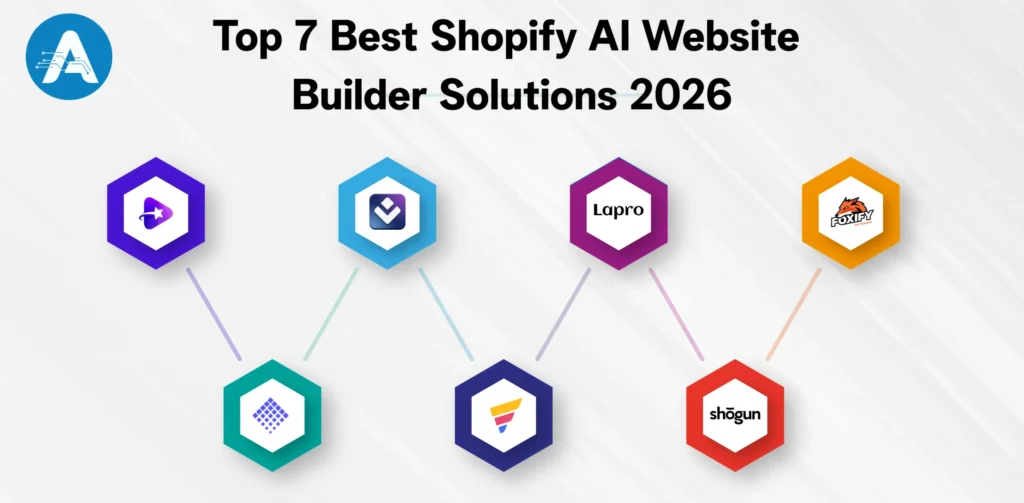
1. Shopify Magic
Shopify Magic is not a standalone builder, but it’s one of the most accessible AI tools for website design and content within Shopify itself. It helps with product descriptions, content creation, blog ideas, basic layouts, and image improvements without adding extra apps. You will find all inside your Shopify dashboard. This AI website builder is apt for Shopify users who prefer simple AI support without installing third-party tools. All its advanced features have helped stores reduce content writing time by almost 25 per cent.
Key Features
- Automated descriptions
- SEO-friendly text generation
- blog topic ideas,
- basic image edits
- smart content suggestions
If you are looking for a simple AI website builder with built-in features at no extra cost, then Shopify Magic is ideal for effortless store management.
2. Atlas AI Store Builder
Atlas AI is one of the most popular Shopify AI website builder tools because it can create a complete store in less than a minute using only a product link. It collects product data, builds layouts, writes persuasive descriptions, improves images, and sets up the entire website automatically. It works like a full AI website generator for fast Shopify launches. Furthermore, it is ideal for beginners, drop shippers, and busy entrepreneurs who want an instant store without manual designing. Many users say it saves hours of work per product.
Key Features
- AI-generated layouts
- Optimized product pages
- Improved product images
- SEO ready content
- Automatic store setup
- Instant product import from Amazon or AliExpress
If you want the fastest way to launch a conversion-ready Shopify store with almost no effort, Atlas AI gives you complete automation from a single prompt.
3. Lapro.io
Lapro.io mixes AI layouts, conversion-focused copywriting, and instant testing. It is made especially for e-commerce brands and drop shippers. It can create complete product pages in a few seconds by pulling product data from marketplaces like Amazon and AliExpress. It is apt for small and mid-sized brands, drop shippers, and entrepreneurs who want fast product launches. After switching to its templates, many users report improved sales.
Key Features
- Multilingual AI product pages
- Strong conversion templates
- AI-powered layouts
- Built-in testing and optimization tools
- Many users report improved sales after switching to its templates
If you care more about speed and conversions than deep custom design, this tool is perfect for launching products or testing niches quickly.
4. Foxify
Foxify is an affordable yet powerful Shopify AI website builder. It is known for clean templates, AI support, and a simple drag-and-drop editor that suits new and budget-friendly store owners. It is apt for small businesses, new entrepreneurs, and budget-conscious sellers.
Key Features:
- Ready-made templates
- AI-generated copy
- Easy drag and drop editing
- Mobile-friendly layouts
- Sticky add to cart features
- Low-cost plans
If you want stylish pages without spending too much, Foxify gives you great value with AI support.
5. PageFly
PageFly is one of the most widely used AI page builders for Shopify. It is great for creating fast landing pages for promotions, seasonal offers, and product launches. It is simple, beginner-friendly, and very quick to work with. It is ideal for stores that need quick landing pages for campaigns or new product releases.
Key Features:
- AI-assisted templates
- Simple drag and drop editor
- Countdown timers
- Reusable blocks
- Mobile-optimized pages
- Smooth Shopify integration
If you want clean landing pages in minutes without any coding, PageFly makes the process extremely easy.
6. GemPages AI
GemPages AI offers both creativity and intelligent automation. You get full drag and drop control along with AI suggestions for layouts, page sections, and sales-focused designs. It is ideal for people who want freedom in designing while still getting support from AI. It is apt for store owners who want flexible design options with smart AI guidance.
Key Features
- AI-assisted page layouts
- Conversion-focused elements
- Simple drag and drop editor
- SEO friendly blocks
- Mobile optimization
- Split testing tools
If you love designing but want AI to help with ideas, structure, and performance, this tool gives you the perfect balance.
7. Shogun Page Builder
Shogun is loved by advanced users because it combines AI assistance with deep customization. You get complete design freedom, reusable page sections, very fast loading pages, and powerful testing features. It is ideal for large stores, scaling brands, or advanced sellers who need strong design control.
Key Features
- AI layout suggestions
- Custom page building
- Advanced testing
- Reusable design blocks
- Performance optimization
- Full creative control
If you want enterprise-level customization with AI guidance to improve conversions, Shogun is a strong choice.
Best Shopify AI Website Builder Tools (2026)
| AI Website Builder | Best For | Key Features | Why choose it |
| Shopify Magic | Shopify users who want simple, built-in AI tools | AI descriptions, SEO content, blog ideas, basic layouts, image edits, and content suggestions | No extra apps needed, reduces content creation time by 25%, easiest AI tool inside Shopify |
| Atlas AI Store Builder | Beginners, dropshippers, busy entrepreneurs | AI store layouts, optimized pages, improved images, SEO content, instant product import, and automatic store build | Fastest full Shopify AI website builder, creates complete stores in under a minute, ideal for fast launches |
| Lapro.io | Small–mid brands, dropshippers, fast product testing | Multilingual product pages, conversion templates, AI layouts, A/B testing, optimization tools | Builds pages in seconds, boosts conversions, great for rapid niche testing |
| Foxify | Budget-friendly merchants, small | Ready templates, AI copy, drag-and-drop editor | Affordable, easy to use, stylish pages with AI assistance |
PageFly | Stores needing quick landing pages for campaigns | AI templates, drag-and-drop editor, countdown timers, reusable blocks, and mobile optimization | Ideal for promotions, seasonal sales, and fast landing page creation with no coding |
| GemPages AI | Store owners who want design freedom + AI help | AI layout ideas, conversion elements, drag-and-drop editor, SEO blocks, mobile optimization, split testing | Balanced AI + creativity, perfect for flexible and high-performance designs |
| Shogun Page Builder | Large stores, scaling brands, and advanced customization | AI suggestions, advanced page building, reusable blocks, performance optimization, A/B testing | Enterprise-level design control, deep customization, and powerful for high-growth stores |
Every coin has two sides, and the same applies to Shopify AI website builders. They offer powerful advantages, but they also come with certain limitations that you should be aware of before relying on them fully.
Limitations of AI Website Builders for Shopify
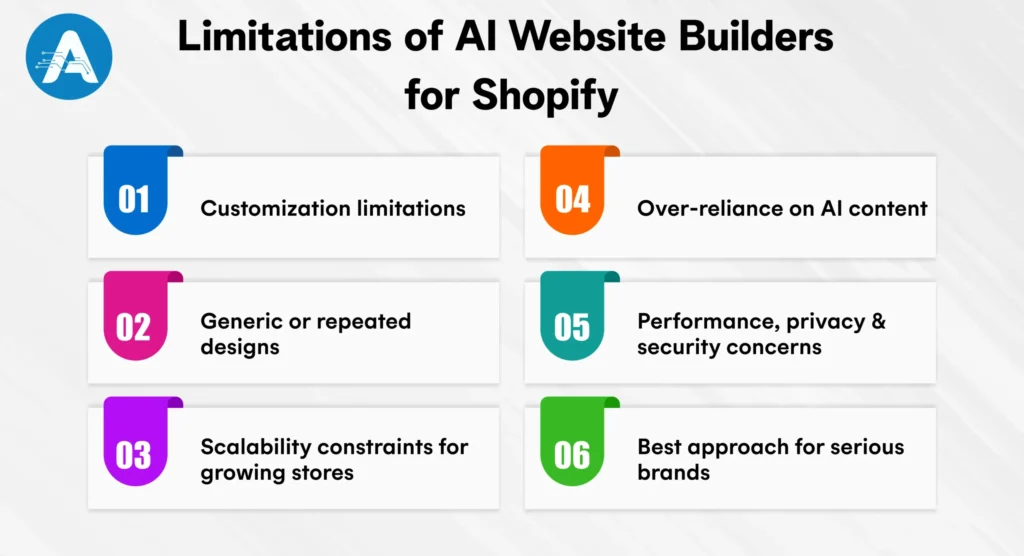
- Customization limitations – AI layouts may not fully match your brand identity, and you may still need manual custom CSS or JS to refine the design.
- Generic or repeated designs – Basic AI builders often generate layouts that look similar, which can reduce brand uniqueness and hurt long-term SEO differentiation.
- Scalability constraints for growing stores – Shops needing complex filters, custom checkout flows, or unique UI may outgrow AI builders and require an experienced AI application development team.
- Over-reliance on AI content – AI-generated product pages and SEO text can sometimes feel generic, requiring manual improvement for stronger ranking and conversions.
- Performance, privacy, and security concerns – Some AI builders depend on third-party tools, which may affect site speed, data control, or long-term stability.
- Best approach for serious brands – AI website builders are excellent starting points, but many businesses later enhance or rebuild their store with professional AI app development services to achieve full customization and better performance.
Wrapping Up
As someone who works on content that actually drives business results, you can see how AI is completely changing the e-commerce game. The gap between your ideas and your execution is getting smaller every day. Now, you can literally wake up with a store idea in the morning and have your Shopify site live by afternoon. What once needed big budgets, long timelines, and full teams is now possible in just a few hours with the right AI website builder or even an AI website builder free option that provides a quick starting point for new sellers.
When you explore the top Shopify AI website builder options for 2025, you will see that tools like Lapro.io and Shopify Magic are great for e-commerce-focused workflows and fast content creation. Builders such as Wix ADI with Shopify, Hostinger, 10Web, and Framer also deliver strong value depending on whether you want quick design, more creative control, or a budget-friendly launch. Each AI builder solves a different need, so the best choice depends on your launch speed and customization goals.
As your store grows, you may eventually want deeper customization, better automation, and advanced integrations. This is where working with an AI application developer or choosing AI application development services can take your Shopify store to the next level by improving performance, adding custom features, and integrating AI-driven automation.